

A comprehensive overview of tourism history

Published by: Oxford University Press
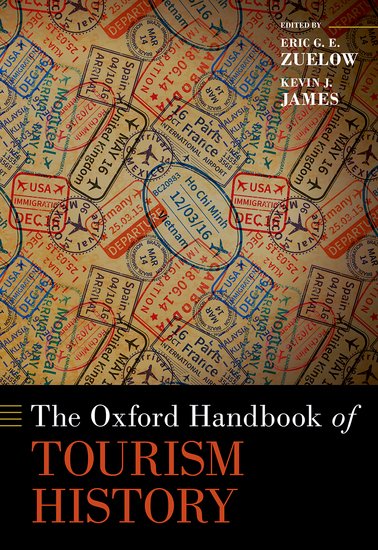
Published online in stages beginning in 2022 and released in print in April 2025, The Oxford Handbook of Tourism History, edited by Eric G. E. Zuelow and Kevin J. James, brings together a broad range of scholars tracing the historical development of tourism. As the editors rightly emphasize in their introduction, history “has lessons to offer” about a phenomenon that, since its emergence as a social and cultural practice, has permeated political, economic, and everyday life and has grown into one of the world’s largest industries (p. xix). Spanning thirty-two chapters across six thematic sections, the volume successfully pursues its two central aims: to “capture the field as it stands” and to “advocate for the study of new subject areas or geographic regions” (p. xxx and p. xxvi).
The handbook already achieves a comprehensive overview in its introduction, where Zuelow and James provide a structured survey of the field, weaving together research traditions, key lines of argument, and regional focuses. Beyond the introduction, some contributions on topics that are part of the canon of tourism history are authored by the scholars who originally developed those arguments. For instance, Gerrit Verhoeven’s chapter on the Grand Tour, Peter N. Borsay’s chapter on Spas and Seaside Resorts, Barbara Schaff’s chapter on Travel Guides, and Shelley Baranowski’s chapter on Authoritarian Tourism deal with themes and debates that have long shaped the field. While these contributions also highlight new research directions and open questions, other essays are more explicitly devoted to “drawing attention to several areas that have attracted little attention to date” (p. xxx).
One of the handbook’s strongest contributions lies in the ways that it unsettles Eurocentric narratives that have long dominated tourism history. In Hospitality and the Shaping of the Tourist(ic) in Modern Japan, 1890–1940, for example, Andrew Elliott observes that although tourism history research has diversified since the 2000s, “many gaps remain about the involvement and practices from states, institutions, and individuals outside the West.” Elliott himself challenges the tradition of treating the “Westerner as the default tourist subject” by turning to Japan during the Edo period. Not only did “noninstrumental pleasure-seeking travel by farmers, artisans, and merchants take place on a huge scale” in Edo-period Japan, but also, as in Great Britain, by the late 18th century, a travel industry was emerging to support these travelers (pp. 486-7).
One of the handbook’s strongest contributions lies in the ways that it unsettles Eurocentric narratives that have long dominated tourism history.
A similar decentering is evident in Gordon Pirie’s Tourism Histories in Africa, which contests the tendency of tourism history scholarship to date the beginnings of tourism in Africa to Europeans’ journeys to Egypt in the 19th century. Pirie critiques this narrative as overly Eurocentric and suggests analyzing earlier forms of travel by Arab and African populations through a tourism history lens. Both Elliott’s and Pirie’s chapters demonstrate how more Eurocentric narratives in tourism history can be interrogated by examining long-standing local travel practices beyond Europe and North America.
Anthony J. Stanonis also challenges the tendency of many foundational texts in tourism studies to imagine the typical tourist as “white, middle class, European or American” (p. 485). In Race and Tourism, he examines not only the ways in which the development of tourist industries within imperial and colonial contexts reinforced racialized hierarchies, for example through the displacement of Indigenous peoples and the racialized organization of service labor at tourist destinations, but also “how people of color pursued vacations” (p. 123). Within the French Empire, for instance, colonial elites of color were encouraged to stay at French spas, where they were largely accepted as “long as they refrained from sexual relations with white women” (p. 122). Such examples illustrate how race, gender, and sexuality intersected in tourism-related contexts, resulting in the simultaneous production of both privilege and discrimination at the same time.
In this context, Stanonis also draws on Eric Jennings’s contribution to the handbook – one of many times that the essays in the handbook successfully engage with one another, despite addressing diverse topics, periods, and groups. In Colonial Tourism, Jennings examines how colonial subjects appropriated imperial leisure infrastructure for their own use. In India, for example, the British had established hill stations and spas “to escape the local, be it local people or local climates” (p. 106). What they had not anticipated was that the local population would adopt the same practices. Initially, local elites and later the Indian middle class also vacationed in the hills during the hot months. As Jennings emphasizes, “much like the colonists, these Indians were tourists” (p. 106).
This attention to the agency of those often-considered mere objects of tourism is also evident in Cecilia Morgan’s Gender and Tourism in the (Very) Long Nineteenth Century. Morgan recounts the stories of the Māori women Makereti Papakura and Rangitiaria Dennan who guided tourists around hot springs in New Zealand and taught them about Māori culture, becoming recognized “celebrit[ies]” in their “own right” (p. 68). In 1911, Papakura, also known as Guide Maggie, even led a group of Māori to the coronation celebrations in London to perform at the Festival of Empire and the Coronation exhibition. Although such travels were “highly mediated by the institutions of imperialism and global capitalism,” they show how tourism developments “also brought increased forms of movement to those who were often the objects of tourism” (p. 69).
Overall, the handbook balances established scholarship with innovative contributions, offering both a roadmap for research and incentives to develop the field beyond its traditional focuses. It is an important read not only for anyone interested in the history of tourism, but also for those who may not have previously seen the relevance of tourism within their own fields.
Louisa Niesen is a PhD researcher in history at the European University Institute in Florence. Her dissertation examines the relationship between the changing leisure travel practices of German-speaking Central European women and the development of related infrastructures between 1880 and 1914. She holds an MA in Cultural History from Utrecht University, where she graduated with a thesis on female employees in the Weimar Republic. Louisa has taught courses at Utrecht University and the University of Padova. With experience in museum work and exhibition curation, she co-convenes the Public History working group at the EUI. Recently, she co-organized a museum curation workshop in collaboration with curators from leading European institutions.