

Credit where it's due: Jewish immigrant bankers and American finance
Published by: Harvard University Press
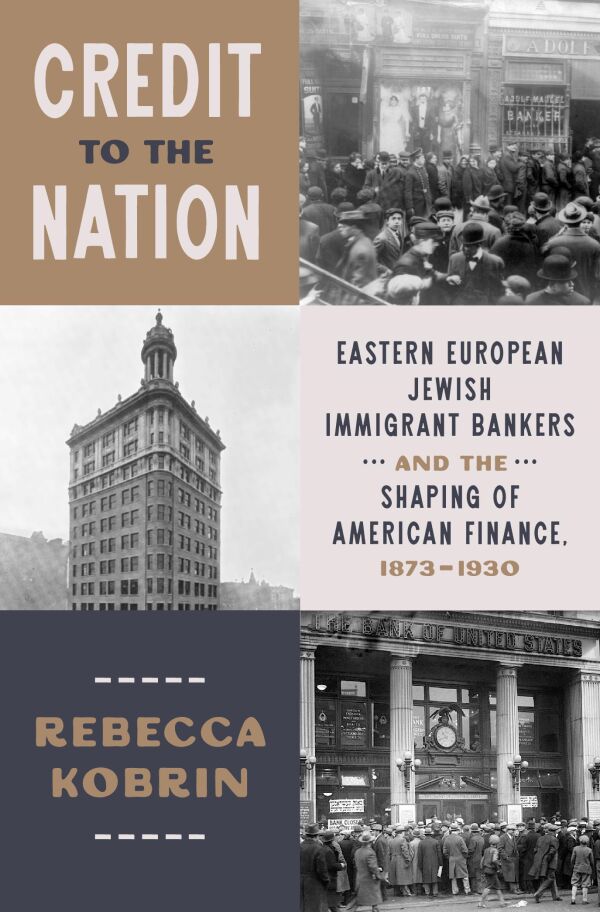
Rebecca Kobrin’s long awaited second monograph tells the story of Jewish immigrant banking in New York City. This is the tale that shows the transnational cultural and financial connections between (mostly) the Russian Empire and the United States from the beginning of mass migration until the introduction of new banking laws that essentially regulated the immigrant bank out of existence. The long arch of Credit to the Nation shows how scrappy Jewish immigrants provided necessary services to New Yorkers, but anti-immigrant sentiment and antisemitism eventually erased this world in favor of the “established” morals of American banking.
Kobrin, a distinguished professor at Columbia University in New York City, situates her contribution between American business history on the one hand and Jewish immigration history on the other. By choosing this topic she manages to paint an image of “mass migration, the evolution of American banking, and the dynamic explosion of New York real estate in the early twentieth century” (p. 5).
At the outset, Kobrin sets up the environment from which the immigrants and immigrant bankers would come, i.e. the restrictive environment of imperial Russia. The first four chapters focus on – as she concisely puts it – “Eastern European Jewish immigrant ship-ticket-salesmen-turned-bankers-turned-real-estate-investors that molded commercial banking” (pp. 209-210). In particular, restrictions on movement and business forced Eastern European Jews “to develop strategies and credit systems to address their economic challenges,” (p. 20) which offers a great insight into understanding the system that would follow them into the US. The big lesson that Eastern European Jews bring from the “old country” is that “any borrower can default. Default is not a reflection of poor moral character, and keeping funds in reserve is not the best overall strategy for profit. […] The implication was that loaning based on character made more sense than loaning based on collateral since the presence of collateral (such as a nobleman’s estate) did not ensure repayment” (p. 36). Kobrin contrasts this with the established “Protestant” (as she says) American way of thinking about credit, as a measure of moral character. Good credit and good morals go hand in hand, but so does the opposite.
Kobrin adds yet another factor, perhaps the most important factor, to this conversation. If would-be migrants did not have access to credit, there was no way they could afford passage westward.
One of the major contributions of this book to migration history is that Kobrin is able to show us that the “Jews were only able to leave en masse because they had the credit mechanisms in place to enable them to pay for their ship tickets” (p. 20). For many years, historians connected the pogroms that began to touch Jewish lives after the assassination of Tsar Alexander II with the great migration of Jews from the 1880s onward. However, demographic research has shown that the places where pogroms occurred were not the places from which people emigrated.1 (p. 42) At the same time, one must bear in mind how expensive that trip was and take stock of the fact that after the devastation of a pogrom, the community simply did not have the resources to send off their best, brightest or strongest to the United States or elsewhere. Kobrin adds yet another factor, perhaps the most important factor, to this conversation. If would-be migrants did not have access to credit, there was no way they could afford passage westward. In the 1880s, a single ship ticket cost an average working-class family over 14% of their annual income. (p. 28)
The main figure in this rise of the immigrant banker was Sender Jarmulowsky, who built a reputation as a trustworthy ship ticket agent and leveraged that into a New York business empire. His prominence became physical with the erection of the Jarmulowsky Bank building on the Lower East Side, “a green iron-grilled skyscraper […] like a tower in a fairy tale, with large domed tempietto on its roof casting a shadow over all the buildings below it.” (p. 74) Kobrin tells us that Jarmulowsky was a larger-than-life figure, a rabbi and a philanthropist, who combined honorable practices with “business acumen” (p. 76).
The ship ticket business took a turn when the shipping companies started controlling the prices more closely and prevented bankers from speculating on the prices. This pushed immigrant bankers like Jarmulowsky into real estate speculation, especially in the development of Harlem, “Manhattan’s first suburb” (p. 123). But they were working both sides of the business: banks provided immigrants with mortgages to buy plots and houses, while also investing the savings of immigrants in Harlem real estate. That created a problem because, at a rate much higher than that of the big banks, they had put other people’s cash into real estate assets. In order to pay back depositors, they would have to liquidate those real estate assets at the same price or higher than what they paid for them.
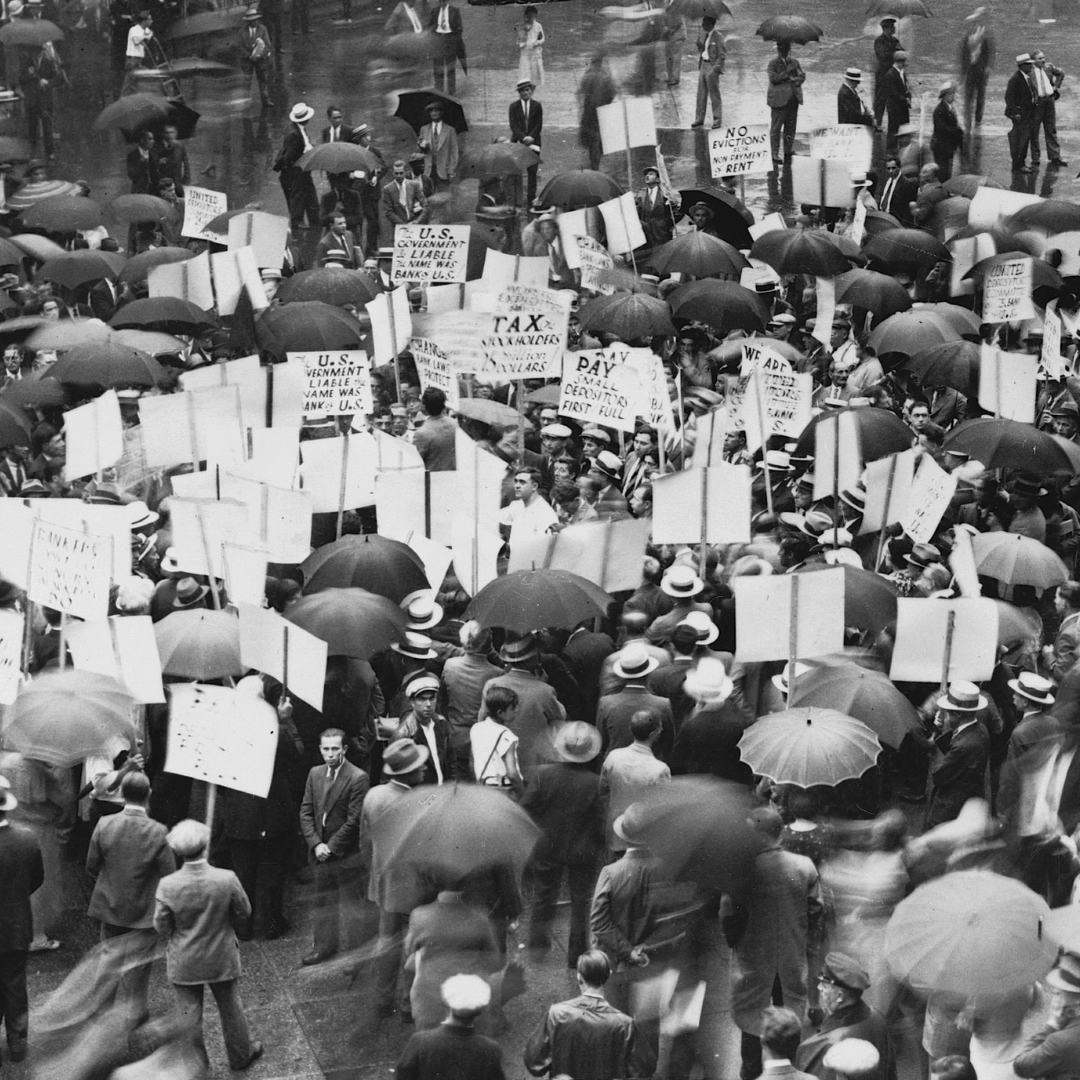
Bank runs and real estate bubbles segue us into the fifth and final chapter, focused on the failure of the Bank of United States [sic]. This was a huge bank with 268 million dollars on deposit and approximately 440,000 customers (pp. 155-6), who were mostly immigrant workers with only small sums to their name. In this chapter Kobrin begins with the failure and then leads us back to understand its history and founding.
A run on the bank in 1930 spread rumors that the bank was insolvent. Tens of thousands of customers attempted to retrieve their money simultaneously but, just as Jarmulowsky had done, too much of this cash had been put into the real estate market and was therefore illiquid. At the heart of this real estate speculation was the Russian-born Saul Singer, a Vice President at the bank who “harbored a distinctly Eastern European Jewish immigrant approach to risk, failure and credit” (p. 157). Singer came to the US as a teenager and rose to prominence in the garment industry before being enticed to take on a role at the Bank of United States. Singer was supposed to use his connections to get as much of the mortgage business as possible in the burgeoning Garment District in Manhattan. The practices of the bank were rather irresponsible: instead of the average 12% of its debt held in real estate, the Bank of United States had 45%, with many second and third mortgages, i.e. refinancing of previous mortgages (p. 179). When depositors went looking for their money, the results were disastrous and many lawsuits followed.
Kobrin uses this rich archival record to perform some original analysis on depositors and bankruptcy proceedings. Using a random sample, she shows that far from being an exclusively Jewish immigrant bank, 42% of the people Bank of United States served were born in the US, 19% in Western Europe, 7% in the UK/Ireland and the rest in Eastern Europe (p. 183). Those native-born Americans and English speakers were overwhelmingly Black, and the bank was providing them with services, even as they were shut out elsewhere (p. 184).
This massive bank failure and the chaos it caused led to a spate of criminal proceedings and new regulation that essentially spelled the end “of the world of Eastern European Jewish immigrant banking” (p. 192). The government perspective contrasted the “Protestant values of hard work, saving and methodical planning” (p. 195) with the supposedly chaotic, unpredictable and irresponsible management of the Jewish immigrant bankers.
Kobrin lands on sympathy for the bankers, an attitude of non-judgement that compels us to understand the cultural roots of their behavior.
This chapter immediately made me think about the Federal Deposit Insurance Company (FDIC) and the rise of further banking regulation, which became hallmarks of the Great Depression and the Franklin D. Roosevelt administration. However, Kobrin hedges on this and says that the bank failure was not directly connected, though the timing “cannot be seen as totally coincidental” since Roosevelt was then governor of New York in 1930 and dealt with the Bank of United States mess (p. 191).
Throughout the book, Kobrin wrestles with the uncertainty of these businessmen. Were they swindlers? Or were they providing a necessary service to underserved people, downtrodden and ignored by banking elites? By the conclusion, Kobrin lands on sympathy for the bankers, an attitude of non-judgement that compels us to understand the cultural roots of their behavior. Kobrin tells us that for immigrant Jews, “meaningful success required taking calculated risks” (p. 208). Indeed, the same could be said for all immigrant groups.
This book had me thinking about the 2008 crash, and how our “stalwart” financial institutions took stupid risks and engaged in dishonest practices. However, concern for their actions did not result in major legislative changes to the banking sector or in criminal proceedings for the bankers responsible. But in the 1930s, when the risk-takers could be labelled as foreign, and perhaps even “un-American,” then it was much easier to legislate in response to their bad behavior. The lesson Kobrin teaches us is that it is not the behavior that matters, but how elite culture perceives that behavior.
Zachary Mazur is a historian of modern Europe with a PhD from Yale University. He is a Senior Historian at the POLIN Museum of the History of Polish Jews and a researcher at the Historical Institute of the Polish Academy of Sciences in Warsaw, Poland. He is the author of numerous articles and the book, To Kill a Spy: Everyday Nationalism and Political Violence in fin-de-siecle Europe (CEU Press). His main areas of interest are in the interactions between law, economics and nationalism.
1 Korbin references Leah Boustan on how the pogroms didn’t result in spikes in migration (p. 42): “Were Jews political refugees or economic migrants? Assessing the persecution theory of Jewish emigration 1881-1914” in The New Comparative Economic History Essays in Honor of Jeffrey G. Williamson, edited by Tim Hatton, Kevin O’Rourke, and Alan Taylor, MIT Press, 2007. Also, Jonathan Dekel Chen et al., Anti-Jewish Violence, Rethinking the Pogrom in Eastern European History, Indiana University Press, 2010.