

Encountering the many "Easts"
Published by: Manchester University Press
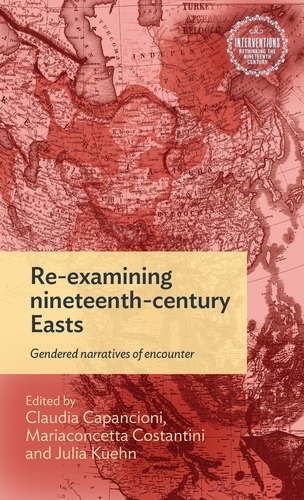
What were the meanings of “the East” for nineteenth-century Europeans? How did they encounter the so-called “Orient”? Was the ideology of European supremacy and colonialism accepted by all of them? What role did gender play in such encounters? Did Europeans’ experiences in the “East” result in changes at home? Finally, are classic works such as Edward Said’s Orientalism, Sara Mills’s Discourses of Difference, Billie Melman’s Women’s Orients, and Reina Lewis’s Gendering Orientalism still relevant to discussions of colonialism, gender, and intercultural encounters? Such questions came to mind while reading the essays collected in the edited volume Re-examining Nineteenth-Century Easts: Gendered Narratives of Encounter, co-edited by Claudia Capancioni, Mariaconcetta Costantini, and Julia Kuehn and published by Manchester University Press in the series Interventions: Rethinking the Nineteenth Century.
The collection opens with a thoughtful introduction that sets out the project’s central objective, which is to “reassess and revitalise the gendered and gendering debates associated with the nineteenth-century ‘East’ or, rather, ‘Easts’” (p. 1). This formulation already points to several important features of the book. First, it deliberately avoids a unifying concept of the East, opting instead for a plural formulation. It foregrounds the complexity of European experiences despite the discourse of shared stereotypes that informed engagements with such disparate places as Albania and Japan, all of which were, in one way or another, described as the “East”. Secondly, the book is neither revisionist nor pioneering; rather, it seeks to reassess existing scholarship and demonstrate the multifarious character of gendered encounters with “the Easts.” This multifariousness is well demonstrated in the fourteen studies that constitute the main body of the volume. They are divided into four parts, each devoted to a particular geographical area: (1) Eastern Europe and the Ottoman Empire, (2) Egypt, (3) India, and (4) the Middle and Far East. As in many other edited volumes, the rationale for dividing individual contributions into sections can be questioned: for a large part of the nineteenth century, Egypt was, at least formally, part of the Ottoman Empire, and the fourth part, devoted to the Middle and Far East, besides chapters on China, Japan and the Malay Archipelago, also contains an article on the Ottoman Empire.
The chapters are relatively short (c. 6,000–7,000 words, including notes and bibliography), and the majority analyse works by one British female author who wrote about the “East.” Some chapters are different in scope—such as a chapter about two Italian women writers, Amalia Nizzoli and Cristina Trivulzio di Belgioioso; a chapter on two Indian Anglophone writers, Krupabai Satthianadhan and Cornelia Sorabji; a chapter on Chinese narratives by Isabella Bird and Alicia Little; a chapter on the male novelist Anthony Trollope; and a chapter on the Indian Rebellion of 1857 in George W.M. Reynolds’s writings and publishing activity—yet they are still written within the same interpretative framework.
All contributions are based on close readings of sources such as travel writing, memoirs, or literary fiction inspired by personal “Oriental” encounters. They revolve around issues such as the role of gender, the potential impact of Eastern sojourns on the biographies of individual authors, the ways and purposes of representing the “Orients,” and the impact of existing discourses on the works under analysis. Some themes, such as depictions of harems, recur in many chapters. Additionally, although contributors approach their sources in various ways, references to particular established works of scholarship, such as the aforementioned books by Said, Mills, Melman, and Lewis, are frequent. This gives the book a remarkable coherence, but it also somewhat limits its impact (more on this later).
Yet their individual encounters with the lands and peoples of Egypt, India, Turkey, and elsewhere, as well as, in some cases, their position as women, allowed them at least partially to transcend the prevailing representations.
Three aspects of the reviewed book are particularly valuable for me. First, all the contributions demonstrate ambivalence in portrayals of the “Easts.” The analysed nineteenth-century authors repeated some clichés and stereotypes, but simultaneously they contested and criticised existing representations. Writing in a period marked by Eurocentrism, racism, and colonial ideology, these authors were inevitably influenced by such discourses. Yet their individual encounters with the lands and peoples of Egypt, India, Turkey, and elsewhere, as well as, in some cases, their position as women, allowed them at least partially to transcend the prevailing representations. However, sometimes even in very positive portrayals of non-European peoples, such as Mary Crawford Fraser’s writings about Japan, the notion of British or European supremacy would appear. Consequently, Re-examining Nineteenth-Century Easts: Gendered Narratives of Encounter helps us reassess our thinking about both contemporary and historical interactions between civilisations, foregrounding their incongruities and ambivalences.
Portrayals of the “Easts” analysed in the book are not only ambivalent; they are also palimpsestuous and multilayered. The concept of palimpsests serves as an interpretative tool in Claudia Capancioni’s chapter on Lucie Duff Gordon’s views of Egypt, and it can be applied to other contributions as well. They convincingly demonstrate the multiple influences, both real-life and literary, that shaped representations of foreign lands. This emphasis on the layered nature of such images is the second very valuable aspect of the book.
Finally, most of the studies demonstrate intricate relations between the metropole and “the Easts.” For example, Margaret Harkness’s writings about India were related to her novels about London slums. From another perspective, for two Italian writers, their stays in the lands of the Ottoman Empire opened career possibilities that were usually reserved for men, thus demonstrating how metropolitan gender norms could be re-evaluated in “the Easts.”
As valuable as the book is, it has its limitations. As I mentioned above, the book is notably coherent, consisting of relatively short and comparable chapters focused on individual authors. Because of this, the chapters remain on the level of interesting case studies, but do not offer deeper, more thought-provoking reflections that could stimulate new ideas or initiate reflection on broader issues. Additionally, what is missing is an engagement with newer theoretical concepts. Generally, the chapters are written within what may be described as a Saidian paradigm, modified by the results of scholarship on “female Orients.” For me, this remains an inspiring way of reading literary works; however, the goal of revitalising debates about gender and the nineteenth-century Easts should also include introducing other concepts, ideas and perspectives into the discussion, for example transimperial history, ecocriticism, the affective turn, etc. These remarks notwithstanding, Re-examining Nineteenth-Century Easts: Gendered Narratives of Encounter is a truly valuable book, both on the level of scholarship demonstrated in the individual chapters and as a collective contribution to ongoing conversations about gender, Easts and intercultural encounters.
Tomasz Ewertowski, PhD, is a lecturer at Shanghai International Studies University, China. He graduated from Adam Mickiewicz University in Poznań, Poland. Since moving to China in 2013, he has been exploring connections between Europe and East Asia. His research interests include travel writing studies, imagology and comparative literature. He has served as the principal investigator for two grants from the Polish National Science Centre. His publications include the monograph Images of China in Polish and Serbian Travel Writings (Brill, 2020) and the edited collection Transport Revolution and Travels to Asia, 1860s–1920s (Routledge, 2025). ORCID: 0000-0002-1133-137X