

Exposing the political foundations of Eastern Europe and Eurasia during the pandemic
Published by: Routledge

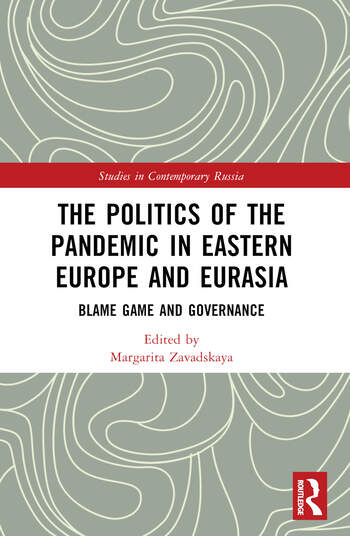
The impact of the COVID-19 pandemic on societies globally is undoubted: hundreds of millions were infected, with millions dead. The response was similarly unprecedented, involving mass lockdowns, large-scale tracing campaigns, and the near-total halt of international travel. The study of the pandemic is therefore of vital importance. While epidemiology and medical science have understandably dominated research agendas, the policy and politics of the pandemic have emerged as fields of inquiry in their own right. One of the most recent contributions to this expanding literature is the regionally focused The Politics of the Pandemic in Eastern Europe and Eurasia, edited by Margarita Zavadskaya.
A keen observer may notice a tension between the title’s ambition and the series in which the volume appears, Routledge’s Studies in Contemporary Russia. While the title suggests a comprehensive overview of political dynamics across Eastern Europe and Eurasia, the content leans heavily toward the Russian case. This imbalance raises a question of scope. The book’s conceptual ambitions extend across the region, yet in practice, many countries are treated only briefly, if at all. At a moment when the discipline is increasingly aware of the historic over-representation of Russia in “regional” studies, this overemphasis feels anachronistic. The omission does not detract from the individual quality of the chapters, but it does leave the reader uncertain whether the book seeks to provide a deep exploration of Russia’s pandemic politics or a comparative study of the broader region.
The opening two chapters address Central Europe and serve as broad contextual overviews rather than detailed analyses. They nonetheless make valuable contributions. The discussion of denialism and conspiracy theories, and their linkage to post-Communist legacies of mistrust, is particularly compelling. Zavadskaya and Caras show how historical experiences with opaque governance structures have fostered enduring attitudes of suspicion toward state institutions, which in turn shaped public reactions to pandemic policy. Their survey research is meticulous, though constrained by the brevity of the section. Sub-regional anomalies, such as Lithuania and Estonia’s divergence from broader patterns of support for COVID-19 measures, are noted but not explored in depth. The authors’ conclusion that a “systematic deficit of institutional and interpersonal trust” underpins widespread conspiracism is persuasive and consistent with later scholarship, yet the analysis would have benefited from a fuller discussion of these outliers.
The argument that health policy can become a vehicle for the deepening of illiberalism is well made and should be required reading for anyone studying the politics of crisis management.
Katalin Miklóssy’s chapter remedies this limitation through its focused comparison of Hungary and Poland. Concentrating on how crisis management can enable illiberal consolidation, Miklóssy’s analysis is both historically and theoretically rich. The discussion of how Hungary’s political traditions shape its contemporary emergency governance is especially illuminating, as is the examination of securitization discourse and its use in legitimizing executive overreach. The argument that health policy can become a vehicle for the deepening of illiberalism is well made and should be required reading for anyone studying the politics of crisis management.
The Russian sections, comprising several chapters, form the analytical core of the volume. They are methodologically diverse and empirically strong, offering valuable insights into both the challenges faced by the Putin regime and those created by it. Vladimir Gel’man’s contribution is particularly authoritative. He persuasively argues that Russia’s poor pandemic governance was not crisis-induced but systemic, the product of a political order that privileges loyalty and control over efficiency and accountability. The parallels he draws with the Soviet handling of the Chornobyl disaster are apt. Once again, political imperatives outweighed public health needs. Gel’man’s analysis lays the groundwork for subsequent chapters, which explore protest suppression, small business resilience, and vaccine resistance within the same structural logic of authoritarian maintenance.
Eemil Mitikka’s chapter on protest and repression is among the highlights of the book. His argument that COVID-19 measures were selectively weaponized to stifle opposition is both intuitive and meticulously evidenced. The discussion of the Vyatkin legislative package and the juxtaposition between heavily policed protests and mass gatherings at UEFA football matches captures the cynicism and opportunism of Russia’s pandemic governance with precision.
The remaining chapters, focusing on Ukraine, Uzbekistan, and a comparative study of Belarus and Kazakhstan, expand the geographical scope of the volume and demonstrate the editors’ commitment to regional diversity, even if unevenly. Each chapter addresses a distinct facet of pandemic-era politics. The analysis of Ukraine’s healthcare reforms under EU pressure (by Nizhnikau) and the examination of Uzbekistan’s “performative state” (by Karshiev and Silvan) both stand out for their conceptual clarity. The Belarus–Kazakhstan comparison is particularly innovative, showing how public resentment toward ineffective pandemic policy paradoxically stimulated civil-society mobilisation in otherwise repressive contexts.
Taken together, these chapters underscore a central insight: crises do not create governance patterns; they reveal and often intensify existing ones. Across the region, the pandemic became a mirror reflecting entrenched deficits of trust, accountability, and state capacity.
The volume succeeds most where it narrows its lens, offering deep, data-driven insights into specific national contexts, even if it falls short of its panoramic title.
Yet the book’s ambition is also its Achilles heel in some respects. The regional framing promises an overarching synthesis that the volume never fully delivers. The heavy weighting toward Russia and the relatively cursory treatment of other post-communist states make it difficult to sustain a comparative argument about “Eastern Europe and Eurasia” as a whole.
Despite this, The Politics of the Pandemic in Eastern Europe and Eurasia remains a valuable and timely contribution. It brings theoretical sophistication and empirical depth to the study of crisis governance, and several chapters will surely become standard references in pandemic politics and post-communist studies alike. The volume succeeds most where it narrows its lens, offering deep, data-driven insights into specific national contexts, even if it falls short of its panoramic title.
Zavadskaya’s edited collection is a thought-provoking exploration of how blame, trust, and legitimacy intersect under extraordinary pressure. Its uneven regional coverage notwithstanding, it provides a valuable resource for understanding how the pandemic exposed, rather than transformed, the political foundations of Eastern Europe and Eurasia.
Jack Dean is a Ph.D. candidate at University College London’s School of Slavonic and East European Studies, where he researches Central and Eastern Europe. His research interests address focus on populism and the politics of health. Outside of academia, he comments on unfolding political affairs in Europe, particularly on Romania.