

International law and the socialist world

Published by: Oxford University Press
When the Soviet leadership burst onto the international stage in the October Revolution of 1917, it secured a reprieve for the consolidation of its power in expectation of a wider revolutionary firestorm by turning to an old institution of international law, a peace treaty. By early 1918, the agreement with the Central Powers formally ended the war on the Eastern Front. As the Union of Soviet Socialist Republics (USSR) emerged in 1922, defined by ideological skepticism towards (international) law as a normative system, its foreign relations were nonetheless regularized by treaties and membership in the League of Nations. The tension between revolutionary mobilization and the search for stability remained. Efforts to elaborate the global parameters of socialist modernity continued to commingle with a concern for state sovereignty, leading to intimate contact with international law.
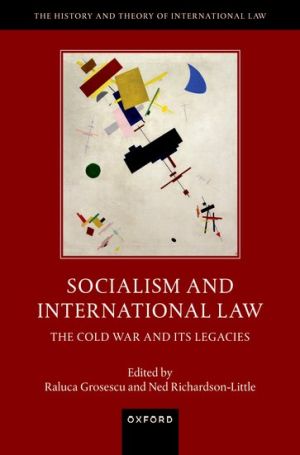
The volume Socialism and International Law, edited by Raluca Grosescu and Ned Richardson-Little, explores this attentiveness of the “socialist world” to international law during the Cold War, capturing it in its generative complexity. With the “socialist world” the editors introduce a concept evoking a looser configuration than the well-worn “Eastern bloc”, emphasizing its plurality and porosity. It persisted in a state of polyphonic dissonance. Externally, it was embedded in an interconnected world, attuned to the rival West, sometimes resulting in joint initiatives on issues of converging interest, but also to the Third World/Global South. In capturing the socialist engagement with international law, drawing on multiple archives and actors, the editors and contributors succeed in showing that it was a challenging, constitutive encounter.
Its publication in late 2024 places it within a moment when our dense lattice of international organizations, treaties and courts has come under attack.
The history of international law, as they lay out convincingly across eleven thematic chapters, has an important socialist dimension. The volume thus focuses on a neglected strand of its “meta-narrative” (p. 1), commonly constructed with a focus on liberal European/Western legal traditions and anti-/postcolonial interventions. Several studies have begun to recover specific socialist contributions to international law. Socialism and International Law has greater ambitions. Traversing the historical sweep of a range of legal questions, it brings into fuller view the distinctive socialist imprint on the embattled international legal frameworks of the twentieth century. Its publication in late 2024 places it within a moment when our dense lattice of international organizations, treaties and courts has come under attack.
The contributions to Socialism and International Law demonstrate the significance of the “socialist world” to the formal development of international law but also its aspirational valence. This depended on (state) socialist participation in scholarship, advocacy and especially the work of international organizations, foremost the United Nations (UN). More diffusely, the volume suggests, it was, at least for some time, also affected by the socialist embodiment of the proposition of fundamental structural change.
The chapters of Socialism and International Law, framed by the editors’ introduction and an epilogue by Paul Betts, compellingly illuminate aspects of this set of historical processes. They recover the socialist involvement in the international legal contestations and compromises surrounding the foundations of (socialist) international law (by Sebastian Gehrig), national and “sovereigntist” legal approaches (by Jakub Szumski and Ryan Martínez Mitchell) and such disparate normative clusters as national self-determination (by Brad Simpson), state aggression (by Michelle Penn), health as a human right (by Bogdan C. Iacob), the protection of cultural heritage (by Nelly Bekus), prostitution and human trafficking (by Sonja Dolinsek and Philippa Hetherington), the criminalization of apartheid (by Raluca Grosescu) and airplane hijacking and terrorism (by Ned Richardson-Little).
Perhaps the most consequential historical shifts traced in all of these contributions to Socialism and International Law relate to the socialist role in laying the legal groundwork for our world of nation-states. International law became a unique terrain of confrontation during the Cold War, its formal universalism questioned and inhabited from outside the limits historically drawn by “civilized” European/Western states, many of them empires cleaved apart by struggles for national self-determination. Socialist investment in this confrontation, with international law sharpened into a “means of politics and social transformation” (22), deepened in the USSR during the post-Stalinist thaw, sidelining scholarly attempts to stake out a “counter-universalist” (p. 11) socialist international law, as discussed by Gehrig.
Socialism and International Law uncovers how the “socialist world” supported decolonization and development through the nation-state by creating a hospitable international legal environment. Efforts in this regard forked out along different legal paths, including the incorporation of the principle of national self-determination into the UN Charter and human rights conventions as well as the recognition of the legitimacy of anti-colonial liberation movements.
Cooperation in this vein with states in Asia, Africa and Latin America – some socialist, some Non-Aligned, some oriented towards the West – was often fraught but, as various contributions reveal, significant in strengthening certain forms and fora of international (legal) politics. The UN and other international organizations were elevated as settings for grand debates, important resolutions and the attendant reconfiguration of moral authority. In this context, the socialist perspective on the legal structure of international economic and financial systems, a focal point of Third World/Global South internationalisms expressed in the 1970s in the New International Economic Order, is, surprisingly, left largely unexamined.
Socialism and International Law shows clearly that criticism of the hypocrisies of international law was not only directed towards the “Western bloc”. It roiled the “socialist world” from within, especially concerning the aggressive domination the USSR exerted over Eastern Europe. As Szumski discusses, legal scholars in Poland, doctrinally inclined towards state sovereignty, labored under the “threat of Soviet violence at the heart of the project” (p. 96). As China became a “third power”, similarly steeped in historical concern for its sovereignty, criticism of the USSR was also articulated in terms of a more strident revolutionary socialism, as analyzed by Martínez Mitchell.
Some of the authors draw necessary attention to “contradictions and duplicities” (p. 8) in discussing socialist achievements. Formal results, we learn, were regularly left unratified by socialist states and undercut by countervailing policies. This raises the question of the interplay not only of domestic and international law but also of legal expertise, official legal positions and politico-ideological priorities under one-party rule in socialist states, which could have been discussed more fully at times.
It speaks to the rich insights offered by Socialism and International Law that it invites so many questions
The premise of socialist engagement with international law is distilled in the introduction as “maximalist theory with weak enforcement” (p. 9), owed to the objective of advancing socialism while insulating domestic jurisdictions from scrutiny and interference. In this regard, the volume could also have examined the implications of state socialist violations of international law more extensively. How should we understand their significance in the context of the dominant “meta-narrative[s]” the volume seeks to disrupt? As Penn highlights in her chapter on state aggression, Soviet international lawyers reproduced long-standing “double standards” in specific terms (p. 76). How did such justifications interlock with official deliberations and foreign policymaking in socialist states? Further research might interrogate more closely the party political and wider institutional ambit of international law in socialist states.
It speaks to the rich insights offered by Socialism and International Law that it invites so many questions, one of which lingers after the epilogue: If the structural pressures of the Cold War spurred attempts to (re-)shape international law, how will the “deferred” (p. 9) successes enabled by the “socialist world” but ultimately dependent on its collapse be affected as our international (legal) order undergoes profound realignments?
Sandra Ricker is an Ax:son Johnson Postdoctoral Fellow at the School of Advanced International Studies at Johns Hopkins University working at the intersection of German, European and international history. She received her PhD from the European University Institute (Florence) with a thesis on internationalism, international (legal) thought and engagement with the League of Nations in the Weimar Republic. Previously, she studied at Heidelberg University and University College London.