

Jewish belonging in East-Central Europe
Published by: Indiana University Press
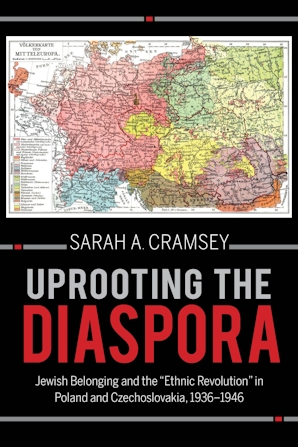
Uprooting the Diaspora examines changes in international, or rather transnational, patterns of thinking about Jewish belonging in two East-Central European countries, Poland and Czechoslovakia. Its unique feature is that it cuts through three short but distinct historical periods: the interwar period, the Holocaust, and the early post-war periods. Sarah A. Cramsey’s work shows how, gradually, between the years 1936-1946, a part of the transnational Jewish leadership, particularly those active in the World Jewish Congress, came to the conclusion that East-Central Europe could no longer be a home for its native Jewish communities. At the same time, the author questions the basic historical teleology related to this problem: the idea that this conclusion was inevitable, even as early as the late 1930s or the beginning of the Second World War.
In Uprooting the Diaspora, Cramsey explains how this came about due to a conjunction of complex historical circumstances in which events directly connected to the Holocaust were arguably less important than the war and post-war reactions to it from Polish and Czechoslovak societies and governments. As she convincingly shows, the East-Central European “ethnic revolution” consisted of such diverse aspects as Nazi-era policies of demographic engineering and various, often non-obvious, wartime and post-war reactions to these policies from both Jewish and non-Jewish victims and their political leadership. Before the physical uprooting and mass emigration of Holocaust survivors, there was an “intellectual uprooting of the Jewish Diaspora.”
It is a fascinating study of transnationalism that transgresses not only state borders but also the boundaries of nations.
A great strength of this book is its comparative perspective, a study of its central problem in two different countries with distinct ethnic compositions, different Jewish communities, and different political cultures. It reveals various unknown contacts and discussions among Jews in Poland; Polish Jews now living in the United States or Palestine; Czech, Slovak, and Subcarpathian Jews; world Jewish leaders; and, finally, Polish and Czechoslovak politicians. It is a fascinating study of transnationalism that transgresses not only state borders but also the boundaries of nations.
Nevertheless, this important book, which I hope will inspire similar innovative research in the future, has its weaker parts. First its uneven focus and expertise on the Polish and Czech contexts, favoring the latter. This is surprising considering not only the fact that 1939 Poland, with its almost 3.5 million Jewish population (compared to around 350,000 in interwar Czechoslovakia before the Munich Conference in 1938), was the biggest center of European Jewry but also because Uprooting the Diaspora almost totally ignores the strength of the Polish discourse of the uprooting the Jewish population of Poland prior to the outbreak of the Second World War. Regarding the war itself, the book concentrates much more on the émigré Czech government’s discussions regarding the future citizens of post-war Czechoslovakia than on similar, no less relevant discussions on the Polish side.
A second issue with the book is that it tells the story of a much smaller milieu of transnational Jewish intellectuals and leaders than its title suggests. It discusses the change in thinking of leaders of only one organization, the World Jewish Congress, ignoring other no less important Jewish milieus not less engaged in the post-war fate of Polish Jewry. A reader of Uprooting the Diaspora will not find here crucial information: that despite everything that happened to Jews in Poland in the years 1944-1946, and the emigration of around 200,000 Polish Jews at this time, another group of 100,000 stayed, rebuilt a politically and culturally pluralistic community, and that reserved faith in the future of this community was shared by important milieus of the Western Jewish world, including organizations such as the American Jewish Joint Distribution Committee or the Jewish Labor Committee. Similarly, the book largely ignores the unique phenomenon of the largely traditional and Yiddish-speaking community of former Subcarpathian Jews that was created in the western part of Czechoslovakia after 1945.1
These weaker aspects of the book do not diminish its importance and value. Uprooting the Diasporarepresents an interesting and innovative approach to both Jewish and general East-Central European history in the middle of the 20th century, and its reading is highly recommended to everyone interested in these topics.
Kamil Kijek is an Assistant Professor in the Jewish Studies Department at the University of Wrocław. He has held various fellowships in the United States, Israel, Germany and the United Kingdom. His research interest are Central and East European Jewish history at the end of the 19th and 20th century, and social and cultural theory. In 2018, he has received an international prize for his publication titled Dzieci modernizmu. Świadomość, kultura i socjalizacja polityczna młodzieży żydowskiej w II Rzeczypospolitej granted by the Leonid Nevzlin Research Center for Russian and East-European Jewry at the Hebrew University of Jerusalem.
1 On these two topics see for example: Kateřina Čapková, “Periphery and the Center: Jews in the Bohemian Lands from 1945 to the Present”, Prague and Beyond: Jews in the Bohemian Lands, eds. Kateřina Čapková and Hillel J. Kieval (Philadelphia: University of Pennsylvania Press, 2021), pp. 235-253; Anna Cichopek-Gajraj, Beyond Violence. Jewish Survivors in Poland and Slovakia, 1944-1948 (Cambridge: Cambridge University Press, 2014).