

Peasant revolutions in Central and Eastern Europe
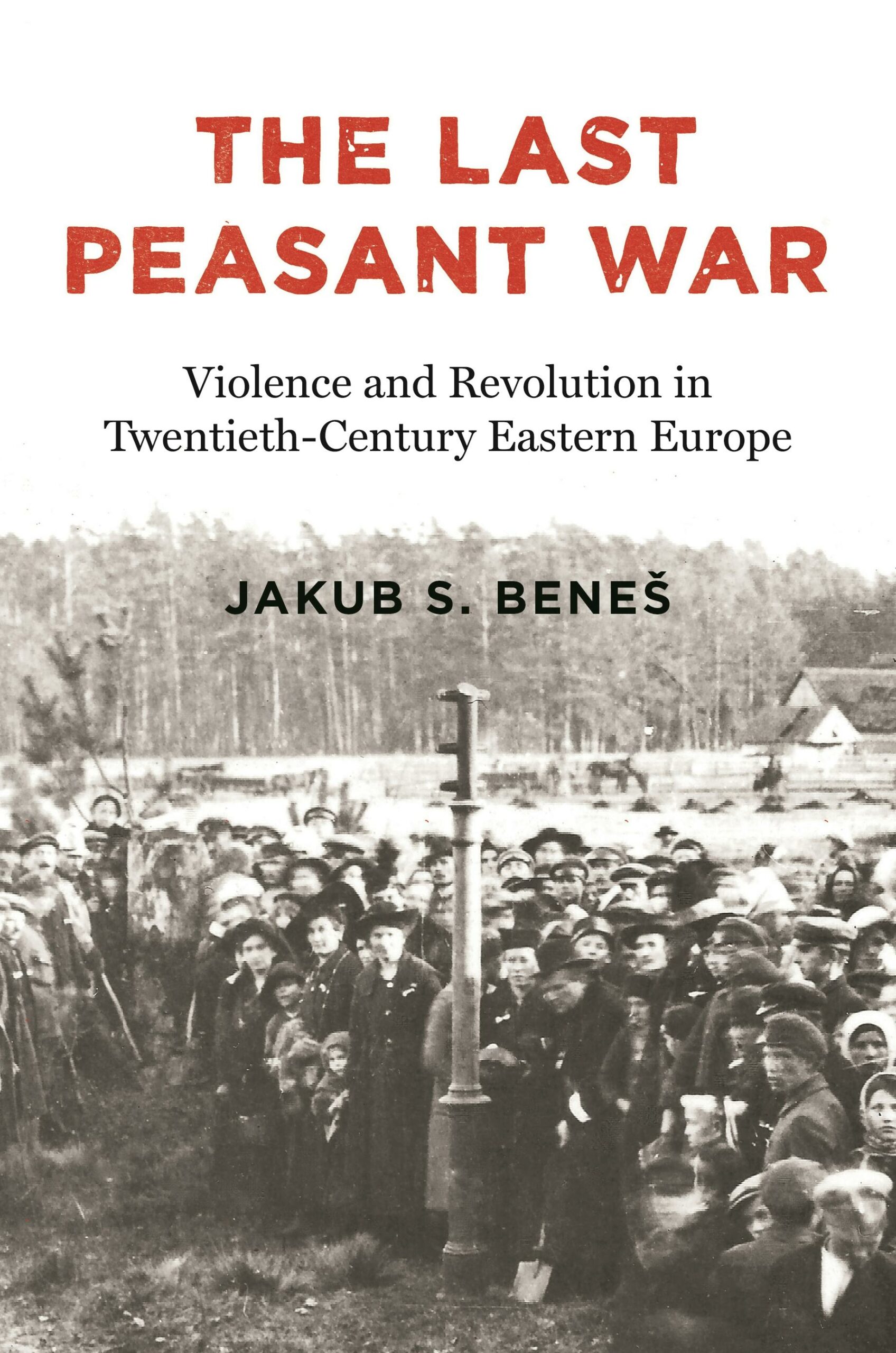
Published by: Princeton University Press
Jakub S. Beneš’s The Last Peasant War: Violence and Revolution in Twentieth-Century Eastern Europe is a major academic intervention. Beneš expands on the works of Eric Wolf and Eric Hobsbawm, as he highlights in his conclusion. Wolf is famous for his 1969 work, Peasant Wars of the Twentieth Century. However, as Beneš is keen to point out, Wolf does not include Europe at all within his peasant wars, outside of Russia up through to the First World War. Hobsbawm famously commented in his 1994 The Age of Extremes that, “the most dramatic and far-reaching social change of the second half of this century, and the one which cuts us off for ever from the world of the past, is the death of the peasantry.” (Quoted in Beneš, p. 302). Beneš fuses these comments, by expanding Wolf’s analysis to argue that across Central and Eastern Europe between the First World War and the immediate years after the Second World War there was a massive wave of peasant uprisings, the titular last peasant war of Europe. Per Hobsbawm, Beneš shows that the peasantry, at least in Europe, did not die without a fight. Beneš challenges the current overwhelming historiographical focus on cities and towns, while also producing a regional analysis that is transnational.
While Beneš brings in some references to Russia and later the Soviet Union, his central regional focus is the lands of the former Habsburg Empire. Beneš shows how in the later stages of the First World War, hundreds of thousands of peasant conscripts deserted from the Imperial army, finding their way back to their home regions, where many formed armed bands. These bands, uniformly, and strikingly, independently named the Green Cadres, engaged in violent resistance against the Imperial state. The Green Cadres variously supported land reform, notions of peasant justice and, depending on their location, either became part of the foundations of the militaries of various post-Habsburg states, or engaged in the establishment of independent regional polities, which Beneš terms peasant republics. From this point, the Green Cadres were either absorbed into a sense of regional patriotism or degenerated into outlaw bands, halfway Robin Hoods. Violent peasant uprisings also surged across the region outside of the more formal structure of the Green Cadre bands, with peasants independently carrying out land reform, attacking towns, burning down the manors of noble landlords, attacking shops and businessmen in towns, and sheltering Green Cadre members. Beneš’s work in this regard matches well with that of Robert Gerwarth, particularly the latter’s The Vanquished: Why the First World War Failed to End, in showing that the violent processes set off by the war continued well after its nominal ending, with our current chronology of war/interwar being an uneasy framework laid atop what was in reality an active bubbling volcano of social fury.
Beneš’s narrative and research offers a new understanding of the dynamics of the interwar period, alongside the process of the Habsburg collapse and the agricultural history of the region. Future historians will be unable to ignore this crucial intervention.
Yet to follow this uneasy chronology, in the interwar period Beneš shows how peasant energy was channeled into a series of influential peasant/agrarian political parties that practiced forms of international solidarity between them. These peasant parties, however, failed to achieve their vision of a peasant form of modernity, characterized by Beneš as agrarian republicanism based on a balance between the town and the countryside. With the failure of the peasant parties, peasant political discontent became an easy target for fascism, and fueled the rise of the far right and fascist parties and states. In the Second World War, however, not all peasants were agents of the Nazis and their fascist collaborators. Peasants formed the backbone of resistance in Central and Eastern Europe, particularly in Yugoslavia. With the defeat of the Nazis, peasants continued to resist Communist collectivization efforts, more or less successfully depending on the country, before the tide of peasant resistance fell by 1950, never to rise again as the mechanization of agriculture destroyed its basis as a social category in the continent. Beneš’s narrative and research offers a new understanding of the dynamics of the interwar period, alongside the process of the Habsburg collapse and the agricultural history of the region. Future historians will be unable to ignore this crucial intervention.
There is a conceptual slippage by Beneš on who exactly comes under the umbrella of the term “peasant.” In Central and Eastern Europe there was a large array of differing agricultural practices and economic forms practiced by the people that Beneš writes about and groups together as all of the same category. By the time of the First World War, many men worked seasonally in factories in towns and cities, returning to the countryside only for the harvest and planting. In some areas, men worked in towns during the week, going back to tend fields on the weekends. In others, a handful of farmers would own large tracts of land, leasing the land out to smaller farmers, or hiring day and seasonal landless laborers. In still others, farmers practiced communal co-operative forms of land ownership and labor, parceling out production and harvest. In yet others, noble remnants, most particularly in Imperial Russia, owned vast estates, upon which farmers were engaged in sharecropping and complex debt relationships, well after the formal abolishment of serfdom. Between wealthy independent contracting farmers, landless manual laborers, seasonally migratory semi-proletarian workers, communal subsistence farmers, and de facto agricultural debt slaves, can we really group all of them together under a single coherent category, i.e. peasant? While Beneš at times denigrates the Soviet Marxian concepts of gradations of kinds of peasants, one does not need to subscribe to notions of the truth value of the concept of the kulak to take into account that inequalities and differences within the predominately farming population in Central and Eastern Europe in the first half of the 20th century were fundamental, and often created opposition and conflict.
The problem of appropriate categorization is further complicated by the economic, soil, crop, and climactic variations across the Central and East European region. Some areas specialized in wheat, others rye, potatoes, barley, sugar beets, dairy production, fruit production, flax seed, and maize, among many others, each of which requires different harvesting and growing practices, alongside different seasonal rotations, and different zones of prime cultivation. To what degree did the actual substance of what peasants grew, in terms of the economic impact of prices, supply, and growing practice, influence their behavior during this time? Did agricultural mechanization play any role at this time in peasant discontent? What about advances in fertilizer technology, and issues of access to such technology? Beneš portrays a highly homogenous peasantry in the book, seemingly all of them growing the same crops and in the same way, such that little difference exists between the peasants of Galicia and those of Slavonia, beyond their language, and that they were all cookie-cutter farmers.
Beneš shows that Central and Eastern European history has numerous potentialities for ground-breaking research.
A further uncertainty within the book is the matter of religion. The peasants of the time in Central and Eastern Europe were predominately Christian, with their loyalties largely to either the Catholic Church or Orthodoxy. Historically, the classic characteristic of peasant uprisings in Europe was that of apocalyptic millenarianism. Violent land reform always carried a connotation of the Second Coming. The re-ordering of land on earth entailed the cosmic re-ordering of the divine. Religion is mostly absent from Beneš’s account, however. Beneš addresses the Catholic or Orthodox component of certain peasant parties at times, or the occasional involvement of a priest, yet only on an episodic basis. He does not have a structural confrontation on the role, or lack thereof, that religion played in the last peasant war. Was there a continuation of the millenarianism of the peasantry at this time? If not, why? How did the Catholic and Orthodox hierarchies make sense of, or attempt to confront, the violent uprising of masses of their flock?
These criticisms are not meant to invalidate or tear down Beneš’s work, but rather to point to further areas of research that are now apparent and open in the wake of the book. Beneš shows that Central and Eastern European history has numerous potentialities for ground-breaking research. Beneš’s own archival research is stunning, with him having dug through numerous regional city and town archives in the Czech Republic, Austria, and Slovenia, national state archives in the Czech Republic, Croatia, Slovenia, and Slovakia, alongside substantial primary sources in Polish and Hungarian. Beneš’s work should function as a guide for future historians who seek to do bottom up, regional, and countryside-focused research. This will be an indispensable book for anyone interested in the legacy of the Habsburg Empire, interwar Europe, and the agrarian history of modernity.
Mathias Fuelling is a writer and critic living in Philadelphia. He received his PhD in history from Temple University in 2025, with a dissertation on economic planning in Czechoslovakia.