

Revolutionary waves in imperial waters
Published by: Berghahn
Sometimes, on our way to the synagogue, my father would tell me jokes. Once, he asked me if I knew the story of the Jew who was stranded on a desert island. I shook my head. He then told an anecdote about a devout Jew who was the lone survivor of a shipwreck and made it to a nearby island, where he became a sort of Hebrew Robinson Crusoe. When a rescue team finally found him, he gave them a tour of the place, proudly showing them how he had brought civilization to the archipelago. A house, a garden, a barn, and two synagogues. “Why two synagogues?” the rescuers asked. The Jew patiently replied, “You see, I need one synagogue to go to and pray. And one synagogue to complain about.”
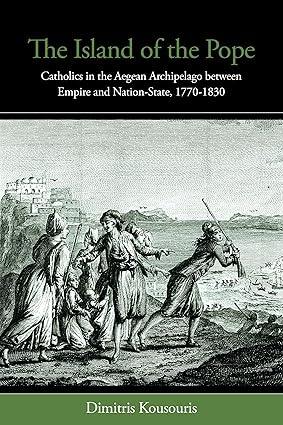
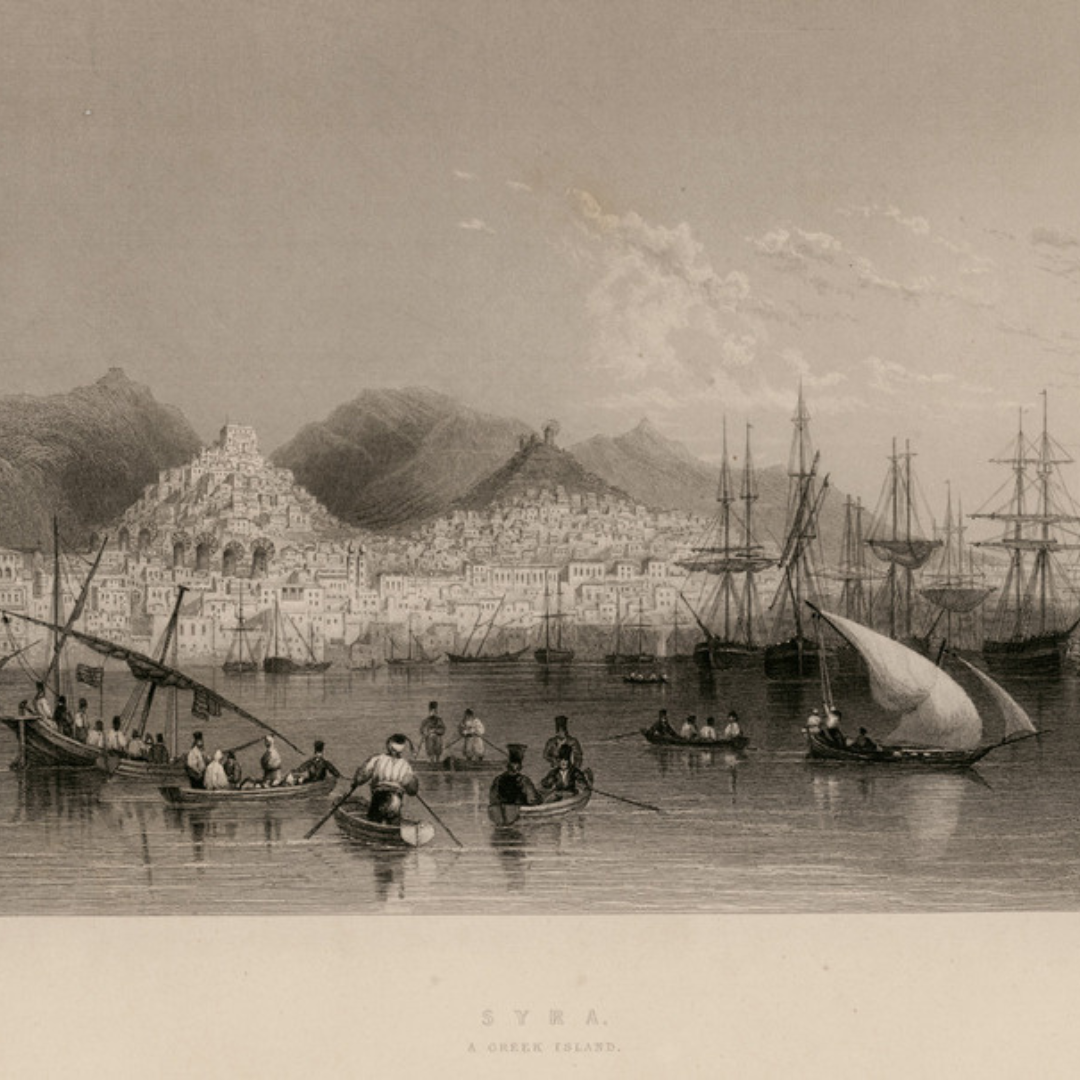
The reader might wonder why such triviality heads a serious undertaking like an academic review. While it might appear to be merely for cheap laughs, it reflects deeper structures not only in Jewish but in general religious history. The historian Dimitris Kousouris, one of the leading scholars on the history of the Greek nineteenth and twentieth centuries, has made similar observations in his new book The Island of the Pope, although, arguably, in a more sophisticated manner. He tells the story of Syros, one of the Cycladic islands, and its religious rifts during the decades of the Greek Revolution. The case of Syros is noteworthy because it had a Catholic rather than an Orthodox religious majority.
Originally writing on the twentieth century, Kousouris chose the deconstruction and repudiation of nationalist Greek history as one of his major goals. This incentive resurfaces in his new book. Following a broader stream of Mediterranean history led by influential scholars, such as Mark Cohen and Molly Greene, he illustrates how Catholic and Orthodox communities sometimes confronted each other and other times cooperated. They would intermarry and visit each other’s churches, making the supposed frontier between religious civilizations, which certain political scientists believed to be a rigid wall, a permeable, makeshift fence. Kousouris avoids essentializing Greek national identity in history, neither fully including nor excluding the Syriot Catholics. By arguing that the national world order was a later phenomenon and that individuals often decided rather spontaneously to which ethnicity they belonged, he defuses old debates about the Greekness of Aegean Catholics. Painstakingly, the historian pinpoints the intersectionality of local nation-building, unveiling links between ethnic, religious, regional, imperial, and social aspects. His history of Syros disproves the ontological myth of a purely national revolution, recovering its true complexities and impact on the daily lives of ordinary people. The existence of a religious minority that understood itself neither as fully Greek nor completely non-Greek on a territory eventually claimed by the nation-state destabilizes the idea of clear ethno-confessional fronts and innate property rights.
Colorful characters, such as constantly bickering bishops, the Capuchins and Jesuits, and even the Pope himself, get caught up in this struggle.
Since Kousouris rejects the nationalist strategy of making a specific community the sole protagonist of his history, the conflict between different groups becomes the center of his narrative. While he remarks that the inhabitants usually preferred peace to open conflict, his true interest lies in the scandalous, violent, and, I admit, exciting rivalry between local factions. Kousouris relates how there was not one, but many overlapping struggles among regional and imperial actors. A major focus lies on the internal quarrel among Catholics. Colorful characters, such as constantly bickering bishops, the Capuchins and Jesuits, and even the Pope himself, get caught up in this struggle. A second conflict takes place between the Syriot Catholics and the Orthodox population, most of them newcomers, refugees, speculators, and pirates, washed ashore by the tides of war. In the book, the position of the newly created Greek government in this face-off remains ambivalent. At first, the revolutionaries appear to be another enemy, pressing money from the already destitute Catholics. Later, with the arrival of Ioannis Kapodistrias and after the war, Kousouris concedes the Greek state a more moderate and mediating nature. In the book, the Ottoman side seems to play a lesser role. If this circumstance is due to an actual absence or the historian’s selection of sources, I do not know. At times, the narrative becomes somewhat convoluted due to the broad array of different characters. The volatility of alliances and hostilities makes it difficult to consistently grasp the connection between the various factions. This circumstance, however, is to be explained by the complexity of the interconnected conflicts that shaped Syros’ history in the 1820s.
Kousouris demonstrates how global power relations, regional struggles, and local renegotiations were deeply intertwined and how a small island was caught in the maelstrom of history. His book reminded me of a series of recent publications, such as Lucy Riall’s history of the Fatti di Bronte, or Dominique Kirchner Reill’s take on the Fiume Crisis, highlighting the importance of actual places and people for imperial politics and vice versa. Kousouris’ Island of the Pope is another exciting and immersive addition to this line of literature. It makes politics and conflicts in the nineteenth-century Cyclades palpable, personal, and engaging. I would argue that it assigned Syros its just position as a protagonist in the history of the Greek Revolution and, probably speaking for many scholars working on the Mediterranean, state that we want more books of this kind.
Paul Csillag is a historian of the Mediterranean world with a particular focus on imperial actors and transregional mobility. He studied at the Universities of Innsbruck, Toulouse, and Yeditepe, and completed his Ph.D. at the European University Institute in 2024. His teaching career has taken him to Florence, Innsbruck, Regensburg, Salzburg, Sciences Po, and Monash University. He recently coordinated the Austrian Studies Doctoral College and the Justman Project at the University of Innsbruck. His current research, conducted at the South Tyrolean Mining Museum, traces the global trajectories of Tyrolean miners who migrated to the Mediterranean and beyond during the early modern period.