

The algorithmic condition and its limits
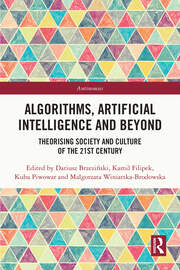
Published by: Routledge
In 1979, French philosopher and sociologist Jean-François Lyotard argued that the computerisation of society was transforming both the circulation of knowledge and its conditions of legitimacy. What counted as knowledge, who could produce it, and under what institutional arrangements—all of this was being reshaped by the very logic of information processing. In hindsight, The Postmodern Condition was less a diagnosis of culture than a warning about epistemology: when knowledge becomes a commodity optimised for transmission, something is lost that adding more data cannot recover.
The editors of Algorithms, Artificial Intelligence and Beyond invoke Lyotard as their organising ancestor, and the analogy is compelling. Their volume—emerging from a symposium at the 2022 Polish Sociological Congress and now published in Routledge’s Antinomies series—argues that we inhabit an “algorithmic condition” as consequential as the postmodern condition Lyotard described. The twelve chapters, drawing on sociology, political science, cultural studies, media theory, and science and technology studies, represent a genuinely international effort to theorise what that condition means for power, culture, inequality, and memory. The volume succeeds in establishing the algorithmic condition as a total social formation requiring interdisciplinary response. What it cannot do—and what makes this question urgent—is account for the kinds of knowledge that resist being theorised at scale. What is at stake is not simply how we analyse algorithmic systems, but what counts as knowledge at all.
The volume’s scope is ambitious. Its five parts move from foundational theoretical frameworks (Seyfert’s relational theory of algorithmic sociality, Filipek’s practice-theoretic account of AI) through theories of modernity (Elliott on predictive analytics and human autonomy, O’Hara on “Zuckerberg’s Cave”) to culture and society (Brzeziński on algorithmic nostalgia, Filiciak and Piwowar on AI narratives), power and politics (Roberge et al. on “vectorial politics,” Liu on political economy), and critical theory (Lutz on digital inequality, Górska and Jemielniak on racial bias in image generation). The range is impressive, and so is the quality of the strongest contributions. Roberge, Chartier-Edwards, and Grenier’s account of vectorial politics—by which the epistemological logic of machine learning migrates into political theory itself—is among the sharpest diagnoses of AI’s ideological function currently available. Their formula—capture, flatten, plot, release—names the algorithm’s mode with precision: data is harvested from social environments, reduced to computable variables, arranged within a matrix, and returned to the world as if it were neutral description. O’Hara’s “Zuckerberg’s Cave” updates Plato’s allegory with philosophical seriousness and a genuine feel for irony: unlike Plato’s prisoners, those in the digital cave know they are in it and prefer to stay, because the modelled representation appears more reliable than the noisy reality. And Górska and Jemielniak’s empirical study of racial bias in text-to-image generators—finding that 87 per cent of identifiably human professional images are coded as white, even where the actual profession is majority non-white—gives the volume’s critical ambitions the evidence they require.
the algorithmic condition—as the volume shows to great effect—is above all the dominance of a particular epistemic mode.
Yet reading this volume from beginning to end produces a mounting unease that goes beyond disagreement with any individual chapter—a limit that becomes visible precisely because the volume is so wonderfully thorough. Every framework deployed here, however effective or critical its intentions, operates through a shared way of knowing: abstraction, scalability, then generalisation. The volume can theorise about knowledge that resists formalisation, but it cannot theorise from it. And this matters, because the algorithmic condition—as the volume shows to great effect—is above all the dominance of a particular epistemic mode. The question the volume does not ask is whether its own theoretical practice begins to mirror the logic it seeks to analyse not despite its critical ambitions, but through them.
Take the volume’s treatment of fluency. Filiciak and Piwowar demonstrate how Big Tech narratives achieve cultural dominance through rhetorical smoothness: the “cloud” metaphor normalises extractivism by hiding material infrastructure, while “artificial intelligence” attributes to machines a form of human cognition that flatters their makers. Roberge et al. show how vectorial politics achieves its power by making society legible in mathematical terms, collapsing irreducible social complexity into manageable variables. The volume’s collective diagnosis of fluency is acute, yet its own theoretical language remains highly fluent. It moves from Lyotard and Giddens to Castoriadis, Wenger, Boym, and Baudrillard with impressive ease, assembling a theoretical apparatus as efficiently as an algorithm assembles its training data. This is good social science. But that fluency also has a cost: it cannot hold what stammers, contradicts itself, refuses to be indexed. What remains at each stage of capture, flattening, and release is left unasked.
A related problem—call it a scalability problem—emerges most clearly at the intersection of Brzeziński’s chapter on algorithmic nostalgia and Górska and Jemielniak’s empirical findings. Brzeziński coins the term “quantified nostalgia” to describe how platforms such as Facebook’s “On This Day” surface memories statistically likely to resonate, filtering out content predicted to cause distress and promoting what is expected to produce warmth. The algorithm does not remember; it just generates the most probable memory. Górska and Jemielniak’s study demonstrates the same dynamic in professional image generation: outputs gravitate toward the statistical centre of their training data, producing whiteness as a mathematical tendency. Both findings illuminate what scalability does to singularity: it produces a central tendency, a most-probable output, and a distribution that is accurate in aggregate and therefore wrong about each particular case. What is lost is both detail and a different kind of epistemic claim: a specific case matters precisely because it cannot be subsumed under a general pattern.
These are not memories but models, and the difference matters.
The volume is collectively aware of this problem. Górska and Jemielniak acknowledge that their binary white/non-white classification obscures internal diversity. Lutz shows how digital inequality compounds across levels, producing patterns that are structurally legible but individually invisible. Yet neither chapter can name what is lost in the process of flattening. Doing so would require a theoretical register attentive to singular cases, to archives organised around irreversible loss, to forms of knowledge that resist incorporation into scalable systems. The volume’s frameworks are designed to explain how systems work, not what escapes systematisation. This is not an oversight but a consequence of the contributors’ disciplinary commitments.
This limitation becomes clearest in the volume’s treatment of memory. Brzeziński’s concept of “foreverism”—the logic by which AI reanimates the past in the present—is one of the book’s most original contributions. The 2023 The Beatles single “Now and Then,” assembled from a 1977 Lennon home demo using AI audio separation, and the ABBA Voyage concerts, performed by hyperrealistic avatars of the band in their 1970s form, exemplify this shift. These are not memories but models, and the difference matters. Yet the conceptual vocabulary Brzeziński draws on—nostalgia, simulacrum, retromania—treats memory as a cultural commodity subject to manipulation and commodification. What it cannot address is the status of forms of memory constituted under very different conditions: archives shaped by rupture rather than continuity, knowledge produced under constraint, or memory reconstructed under pressure and always incompletely. In such fragile and unstable contexts, the question is whether the model can be distinguished from the material at all—and what is at stake when it cannot.
Some forms of knowledge are not simply difficult to scale: they are structurally non-scalable.
O’Hara’s “Zuckerberg’s Cave” offers the volume’s most philosophically precise account of this problem. His claim that the digital world produces a kind of data mysticism—a belief that the model is more real than the thing it models—captures with clarity what is at issue when algorithmic systems are trusted over the partial, contradictory, and affectively disorganised knowledge of human subjects. His discussion of the limits of this system—geopolitics, cybersecurity, economic constraints—identifies practical barriers to its expansion. Yet the encounter the volume cannot stage is the one in which the system meets forms of knowledge that are organised around the irreducibility of the particular event or the silence that precedes or follows speech.
To be sure, this is not a plea for a return to humanism against the algorithmic condition, which is here to stay. Rather, the volume invites a fresh path of inquiry: systems seem to become most legible at their limits, and the limits of the algorithmic condition are most visible in contexts where data is absent, contested, or constituted through irreversible rupture. Similarly, the volume’s assumptions about data, memory, and retrievability are historically contingent and particularly fragile under such conditions. Some forms of knowledge are not simply difficult to scale: they are structurally non-scalable.
Paradoxically, the volume’s strongest contributions point in this direction. Roberge et al. show that vectorial politics depends on rendering all social experience computable—the ambition to translate the world into adjustable parameters. Their critique is compelling: this is a sharp reduction of society, a political project presented as a technical necessity. Yet the alternatives they offer remain within the same epistemic horizon: more refined theory, more rigorous empirical work, and more attentive critique. These are genuine goods for scholars. What they cannot provide is an account of knowledge that is both better calibrated and organised around encounters, fragments, and resistance rather than capture.
Algorithms, Artificial Intelligence and Beyond is a significant contribution to an essential conversation. It establishes the sociological, political-economic, and cultural coordinates of the algorithmic condition with range and rigour. What remains is to ask whether that condition can be fully grasped within the very terms it makes dominant. In addition to Lyotard’s 1979 The Postmodern Condition, readers might consult his The Differend (1983), where he showed that some wrongs cannot be articulated in the dominant idiom without that articulation reproducing the harm. The algorithmic condition poses precisely this problem. This volume, for all its ambition and erudition, still answers it from within.
Jan Burzlaff is a historian at Cornell University. He teaches and writes on the Holocaust, modern European and Jewish history, mass violence, and the role of AI in the humanities. His recent article “Fragments, Not Prompts” (Rethinking History, 2025) argued that historical writing must resist the fluency of AI and remain attentive to fracture, contradiction, and the limits of interpretation.