

The future possibilities of home
Published by: Verso

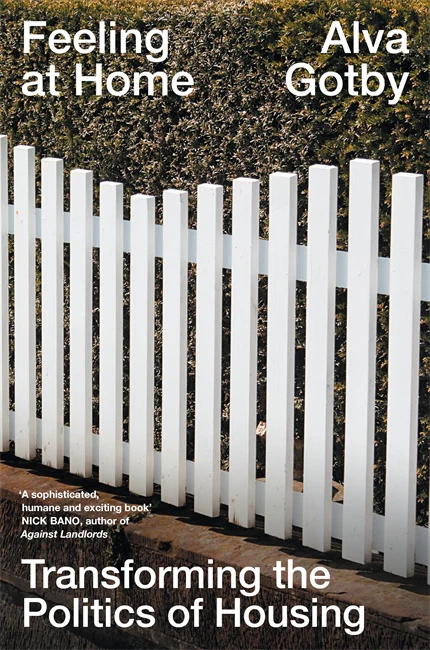
Is home a place? A feeling? Or people? The book Feeling at Home is incredibly complex in looking at “home” as a never-ending process of contestation. Alva Gotby addresses home from different angles – as a feminist issue, a working-class issue, even a climate issue. The word feeling in the title is not coincidental. Social imaginaries (Castoriadis, 1964) about what home represents are so deep, and even the emotions about them are socially constructed, often conflicting with what home means in contemporary societies. For many people nowadays, housing is not only a safe space of rest and joyful relationships, but also a financial and emotional burden. Moreover, this burden is not randomly scattered throughout society, but rather passed down from generation to generation: some of us pay rent, others have a mortgage, some inherit, and some are born into homelessness. How can this housing regime be thought of as just? How can we rethink it if we assume it is not just and that justice is still something we, as members of a society, aspire to?
To answer these questions, the book is organized into eight chapters, with an introduction and conclusion. The goal is to explore what home has become under “rentier capitalism,” in which housing assets are sufficient for owners to live on through the passive rental income (p. 10). The author seeks to blur the boundaries of the private and the public spheres by dismantling and confusing the binary of the associations we have with the two concepts: domestic, private and safe vs. public, potentially dangerous and risky. She heavily criticizes private forms of social reproduction in homes (Chapter 1). She frames housing as a feminist issue and argues that the housing situation for single women and single mothers is objectively more difficult compared to that for men (Chapter 2). She describes tenants’ struggles for decent rents in the UK and the governmental and council policies over the last five decades (Chapters 3 and 7) and the negative consequences of racialized public housing on the health of the tenants (Chapter 4). In Chapters 5 and 6, she delves into the problems of ownership and inheritance. And in the final chapter, she develops more future-oriented thoughts about collective and liberatory forms of housing, which could also help to radically rethink other spheres of people’s lives.
From the position of a scholar, activist, and housing organizer in London, Gotby argues that thinking about housing as an asset is not enough to solve the housing crisis; homes are and could be much more than four walls – in both good and bad ways. Domestic space is what we allow it to be, socially and politically. Homes can be liberatory places of joy and community, but also places filled with the potential for domestic violence, involuntary (women’s) work, and oppression. For vulnerable people, in regimes where housing is unaffordable for different groups, they are forced to stay in households that are not safe, joyful, and healthy. Structurally, lower-income women and other groups may end up staying in abusive relationships or inappropriate situations (p. 37). Violence is committed not only by domestic partners or relatives, but also by property owners and leasing agents, primarily against women, in sexual and racialized ways (p. 39). Moreover, the uneven power relationships concerning factual “ownership” of the space in the home, oppression by property owners can be difficult to fight. In these situations, Gotby states, “[W]e often cannot experience ourselves as actors with agency to substantially change our circumstances” (p. 46). In other words, we can’t be free within the space in which we should be able to rest, recharge, and be “safe” from the dangers of the public sphere. The physical space of the home, the legal aspects of housing. and the financial burden of homemaking are thus undoubtedly crucial aspects of an unjust system that requires rethinking.
the debate about what home means, what function it has or should have, and how social relations and reproduction are organized around the home-space under capitalist regimes is insufficient and underestimated.
In the housing debate, the stakes are highest as regards financialization: many people agree that we need more affordable council (public) housing. This emphasis is, however, only one side of the coin. In a chapter entitled “Demanding more, demanding better,” Gotby argues (and I agree with her) that we need more public housing, but what that should look like isn’t always clear. Representations of home are still bound to the idea of privacy for nuclear families. The design and unifying character of council (public) housing is a “soft” aspect that presupposes certain domestic constellations of kinship and work patterns, not the case for many households today. The author provides historical examples of council housing and is critical even towards the best examples of this type of housing, such as Red Vienna, a term used to describe the period during which the Social Democratic Party in Austria built and successfully provided affordable social housing with useful common areas, for lower social classes (p. 122). She critiques this type of housing from a Marxist perspective and argues that council housing has always been designed for the social reproduction of the working class, excluding other marginalized groups. In another review of this book, Isobel Araujo (2025) rightly interprets that marginalized people have always been precariously housed and there is no return to a seemingly “normal” pre-financialization era for them. Who exactly is meant by “them”? Apart from migrants, typically an excluded group in both the United Kingdom (Gotby’s reference country) and the United States (Araujo’s home territory), I see many more types of struggling households in Central Eastern Europe (my space of origin): older people pushed towards institutions rather than being supported to live on their own (or in communities); people with mental health issues; single women; young people; (multi-generational) Romani families; single mothers; and even LGBTIQ people who can have problems in finding housing, because of prejudices.
The physical spaces in which people live necessarily entail the concept of home. However, the debate about what home means, what function it has or should have, and how social relations and reproduction are organized around the home-space under capitalist regimes is insufficient and underestimated. Gotby proposes new, collective forms of housing, rather than glorifying council (but private) housing for all. Private forms of social reproduction such as cooking, childcare, and emotional support can’t be, according to her, locked in private homes, if we really want to change the housing situation over the long term. In the final chapter, with the help of two concepts, namely, “domestic realism” and “domestic romance” (pp. 133-135), Gotby shows how housing and our ideas about it are stuck in the “realism” of what already exists. The “romance” of the “American ideal of home and its manifestation, in the form of a suburban one-family house, that have successfully been made transnational” (p. 135), is something desirable, reinforced by decades of advertisements and pop culture. It is understandably difficult to imagine other modes of housing because it would mean imagining other ways of care, work, and social relationships. In the end, imagining different futures can be a frightening practice or a liberatory one if we find enough courage and mutual support.
The book is timely and very up to date, citing important authors in the field of housing and feminist issues, for example, Peter Marcuse and David Madden (In Defense of Housing, 2016), Susanne Soederberg (Urban Displacements: Governing Surplus and Survival in Global Capitalism, 2021) and Sophie Lewis (Abolish the Family, 2022). At the end of Chapter 3, we learn that Section 21 of British law, allowing property owners to evict a tenant without providing a reason, is slowly being dismantled through pending legislation entitled the Renters Reform Bill (this has now been passed as the Renters’ Rights Act 2025). However, the author is persuaded that laws will not save us, and that there is a need for powerful tenant organizations that will not only fight evictions and encourage tenants to fight for their rights but also pursue broader cultural and subjective shifts – in discourse about housing and in collective embodied experiences of justice. This book is also theoretically rich, and with its visionary and inspiring thoughts, it is suitable for all scholars interested in housing policies and the future of housing. It can also help early career researchers to choose an angle for their research about housing and home, a surprisingly complex and problematic field in need of more qualitative and ethnographic studies.
Mgr. Petra Tamášová is a sociology graduate from Masaryk University, having completed her studies in 2020. After graduation, she has worked as a city council officer in Bratislava, focusing on social support for older adults and affordable housing She is a co-author of the Amnesty International Slovakia research on affordability of housing in Slovak cities (2024). Currently, she is pursuing a PhD at Masaryk University, where her research continues focusing on the interactions between housing and aging populations. She is part of HOMeAGE, a doctoral network and research programme on aging, place, and home.