

East, West, Central? Getting to the heart of Prague’s place in history
Published by: Oxford University Press

Photo by Denis Poltoradnev on Unsplash
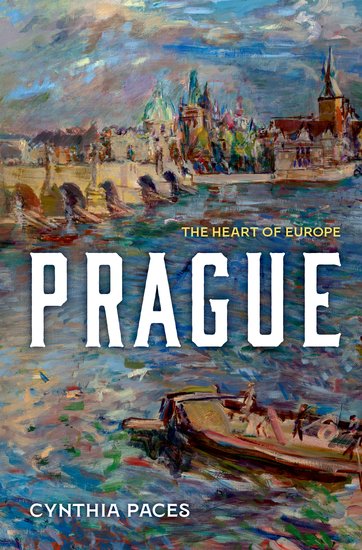
Czech author Ivan Klíma once wrote about Prague, “The word ‘paradox’ also applies to the spirit of this city.” Such is our introduction to Cynthia Paces’s central theme in her recent book Prague: The Heart of Europe, published this January by Oxford University Press. In referencing Klíma’s essay “The Spirit of Prague,” Paces highlights Prague’s historical paradoxes and contradictions, which serve as the “guiding principle” for her book, namely Prague as “central and peripheral; cosmopolitan and provincial; and progressive and intolerant” (p. 2).
Paces explores these paradoxes in her comprehensive history of Prague, examining the origins of the city in the ninth century, when Slavic dukes built the first fortifications on the castle hill. Over eleven centuries, Prague developed into an important political and cultural center, home to a diverse and multilingual population, including Czech and German speakers, among Jewish, Roma, and Sinti communities. The author traces the complicated and often turbulent histories of Prague’s residents, from periods of religious upheaval – such as the Hussite Wars – to the antisemitism, Nazi occupation, and communist regime that defined much of the twentieth century.
Prague: The Heart of Europe serves as a wonderful companion guide for those getting acquainted with the city for the first time, particularly for students and the general public. Paces pays special attention to how historical events influenced the naming conventions of Prague’s sites, such that one learns how the medieval Judith bridge became the Stone bridge, the Prague bridge, and then the Charles bridge. She also traces the fates of bygone monuments, such as the infamous statue of Stalin that once towered in Letná, and the revival of monuments previously taken down, such as the Marian Column (Mariánský sloup) in the city’s Old Town Square which was demolished in November 1918 during a period of “de-Austrianizing” only to be reconstructed in 2020. In this way, Paces demonstrates how the physical sites in Prague continue to reflect the city’s complex history.
Paces’s book is one of several more recent publications which use the history of Prague and its inhabitants as a means to understand broader Czech cultural and political history. Derek Sayer’s Postcards from Absurdistan: Prague at the End of History (Princeton University Press, 2022), for example, uses the framework of various Prague “postcards” and the theme of absurdity (Sayer derives “Absurdistan” from language used by Czech dissidents in the 1970s) to understand Czech cultural history from 1938 onwards. (You can read a full review of Sayer’s book in this publication.) Another book, Chad Bryant’s Prague: Belonging and the Modern City (Harvard University Press, 2021), which I reviewed for this publication, also centers on Prague’s more recent history, concentrating on the late nineteenth century, when Prague was a “German City,” at least in the sense of being a “Habsburg-controlled outpost,” to the early twenty-first century. Bryant examines the lives of five more-or-less marginal historical narrators to explore the notions of identity, belonging, and place. Paces’s work is the greatest in its scope, examining Prague’s history well beyond its contemporary eras. While she takes a more “top-down” approach, relying on the histories and actions of leaders and well-known cultural figures, such as Prague’s emperors, politicians, writers, and philosophers, she also carefully considers the history of women and minorities, communities often overlooked in traditional historical narratives.
Paces shows how the people of Prague and those who ruled the city have existed between the competing “East” and “West” ties over the centuries.
While Sayer and Bryant apply the thematic lenses of absurdity and belonging in their exploration of Prague’s history, the main throughline in Prague: The Heart of Europe is less thematic and more observational. The geographic position as the “heart” of Europe is certain. However, its metaphorical position – politically, culturally, and ideologically – in relation to what is often referred to as “spheres of influence” necessitates more nuanced answers. Paces shows how the people of Prague and those who ruled the city have existed between the competing “East” and “West” ties over the centuries. Prague has “looked” westward, aligning itself with the Holy Roman Empire and later with currents of Western European intellectual and cultural life. At the same time, Prague was shaped by “eastern” influences, such as under the Habsburgs’ eastern entanglements or later under the Soviet sphere of influence. In this sense, Prague’s metaphorical position has been renegotiated throughout its history.
The question of Prague’s metaphorical position calls to mind the famous 1983 essay by the Czech writer Milan Kundera, “A Kidnapped West, or The Tragedy of Central Europe.” In it, Kundera looks to history to argue that Czechoslovakia, and the other “small nations” of Central Europe, are culturally Western, rooted in Roman Christianity. For Kundera, the term “Europe” denotes not a “phenomenon of geography but a spiritual notion synonymous with the word West.”1 Kundera maintains that these small nations were “kidnapped” when absorbed into the Soviet sphere, as they were displaced from their cultural home in the West. Kundera argues that culture defines nations more than geographic borders; he writes, “Central Europe is not a state; it is a culture or a fate.”2 As such, Kundera defined Central Europe as a concept, challenging the East–West binary that was assumed to be an inherent division at the time.
I was surprised that Paces does not mention the essay in her work, given that it touches so directly on the “guiding principle of this book” – historical paradoxes and contradictions. (She does take note of Kundera’s 1965 address at the Writers’ Union Congress, an important work on the significance of literary expression in a small nation.) Perhaps the book would benefit from an exploration of Prague as belonging to the concept of Central Europe, rather than Paces’s more narrow, geographical framing of the city as Europe’s “heart.” She does, however, leave us to consider the future of Prague’s metaphorical position. Paces describes the paradox and contradiction Prague’s citizens find themselves in today: The country is currently led by a “liberal internationalist and former NATO general” president, and a billionaire technocrat and populist prime minister, whose agenda and party often stand in opposition to European Union policies. Thus, Paces’s walk through history shows us that while historical contexts change, the great paradox of Prague’s place – as “eastern, western, and central” – continues to echo in the discourse of today.
Anna West is a graduate of Charles University (Univerzita Karlova) with a Master of Arts in Oral History and Contemporary History. Her work focuses on migration, identity, and memory.
1 Kundera, Milan. (2023), A Kidnapped West: The Tragedy of Central Europe. Faber & Faber, p. 37.
2 Kundera. (2023), A Kidnapped West, p. 54.