

The importance of work and nonwork
Published by: Purdue University Press
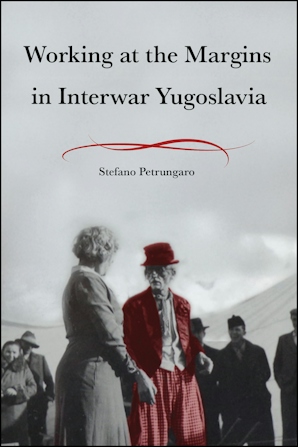
Working at the Margins in Interwar Yugoslavia is a classic application of Michel Foucault’s ideas to the context of work, or rather, nonwork in interwar Yugoslavia, and it is a very good working example of how to draw upon Foucault. As Petrungaro posits, “this study is evidently deeply indebted to the scholarship inspired by Michel Foucault about modern disciplining techniques, biopolitics, and governmentality” (p. xx) and I could not describe the book better myself even if I tried.
The book is divided into six chapters barring the introduction and conclusion. The introduction lays out the purpose of the book, which is to explore the work/nonwork relation in serious consideration. Indeed, the author is correct in stating that “interwar Yugoslavia history and its developments in terms of social disciplining, welfare schemes, and many public and private discourses and initiatives cannot be properly understood” (p. xiii) without understanding this relationship. Petrungaro thus looks at such forms of work as prostitution (sex work/trade/commercial sex would have been a better term, although he uses the words interchangeably in some sections of the book), itinerant workers such as peddlers and wandering artists, midwives and folk healers, beggars and poor people, and other “jobless” people. These categories were not considered legitimate or legal forms of work, that is, work recognized by the new Yugoslav state.
In the first chapter, Petrungaro presents the economic and social problems in establishing the Yugoslav state. There were several issues, including both registered and unregistered unemployment during state formation and the terrible living conditions that many people faced during this period. The state-building and corporatist practices during this tenuous period created many tensions and economic cleavages. With this as the backdrop, the author segues into the second chapter using specific case studies to examine the forms of social engineering that the state conducted.
Petrungaro affirms that it is important to look at each marginalized nonwork because nonwork “is not only the negation of normative work […] normalization processes of ‘work’ need to be placed side by side”.
In chapter 2, Petrungaro considers “prostitution.” He details the domestic prostitution and anti-venereal disease policies that the Yugoslav government engaged in. There were different layers of sex work, he argues, and they were all mostly considered “nonwork.” Petrungaro affirms that it is important to look at each marginalized nonwork because nonwork “is not only the negation of normative work […] normalization processes of ‘work’ need to be placed side by side”. (p. 21) He thus proceeds to place them side by side in this chapter, beginning with the nonwork of sex work.
In chapter 3, he considers another nonwork, namely itinerant workers such as peddlers and wandering artists. These include such people as, both licensed and non-licensed peddlers and magicians, clowns, street musicians, and itinerant cinemas. As Petrungaro asserts, “one of the main hypotheses of this book is getting historical substance.”(p. 64) The author thus gets at this substance by showing that “contrary to the widespread idea that itinerant work is essentially in contrast to modernization […] the development of arts, technology, and culture furnished new tools and materials for nomadic work.” (p. 87)
In chapter 4, Petrungaro picks up midwives and folk healers, again people considered to be in the nonwork sector. He asserts that “together with other medical professionals, the midwife too was the center of a strong modernization process” (p. 90), and he concludes this chapter by observing that “the body of the nation could and should be treated appropriately—from the very first moments of its life.” (p. 110) He thus treats it appropriately in the following chapter 5 by focusing on beggars and “other poor people.” After focusing on the effects of the nation-building process in Yugoslavia on these actors, he concludes that “for a minority of ‘socially recognized’ poor people, the assistance was improved and more efficient, but for all the others, it had become much more difficult to survive.” (p. 144)
In chapter 6, the author turns his attention to jobless people, whom he defines as those in search of employment. He argues that a new idea of unemployment emerged during the period under consideration in Yugoslavia and that “nonwork acquired concrete features, embodied in even physical spaces and buildings.” (p. 169) Finally, Petrungaro concludes the book with the assertion that “the political class, supported by members of the civil society, intensively dealt with issues aimed at shaping the new Yugoslav society.” (p. 171) Indeed, he underscores that there was a “convergence” of different Yugoslav elites with local experience (p. 173).
Similar work is being done in the context of non-Western countries too, such as India, China, and Ethiopia, although the author does not draw upon or refer to it in this book, and perhaps the study would have offered a richer Foucauldian tapestry if he had. Specifically, Marco Di Nunzio’s scholarship on Ethiopia and Sanjay Seth’s work on India come to mind.[1] It should also be noted that the book omits other kinds of scholarship in the field that do not draw on Foucault, such as the body of work that has come out of the writings of Ruth Wilson Gilmore, Orlando Patterson, and Cedric Robinson, and this omission may disappoint readers seeking different avenues of inquiry and analysis.
Nonetheless, admirers of Foucault will greatly enjoy and be inspired by the author’s arguments, and I recommend this book to such readers. However, this is not a book for readers who have grown weary of Foucauldian analysis. To those familiar with applications of the Foucauldian framework to work and nonwork in other parts of the world, the book may offer few surprises. Its originality lies in applying this framework to interwar Yugoslavia.
Ambika Natarajan is a Visiting Faculty at the UM-DAE Centre for Excellence in Basic Sciences, Mumbai, India. She is the author of Servants of Culture: Paternalism, Policing, and Identity Politics in Vienna, 1700-1914 (2023) which was a 2023 Waterloo Centre for German Studies Book Prize finalist. Her article entitled “Evolution of Servant Laws in the Habsburg Empire,” in the Journal of Austrian Studies won the 2025 Max Kade Prize.
1 See, for instance, Marco Di Nunzio, “Work, Development, and Refusal in Urban Ethiopia,” American Ethnologist 49, no. 3 (2022): 401-412; Sanjay Seth, “Foucault in India,” In Foucault and the History of Our Present edited by S. Fuggle, Y. Lanci, M. Tanzzioli (London: Palgrave Macmillan, 2015).