

The life of Aleksandr Tvardovskii
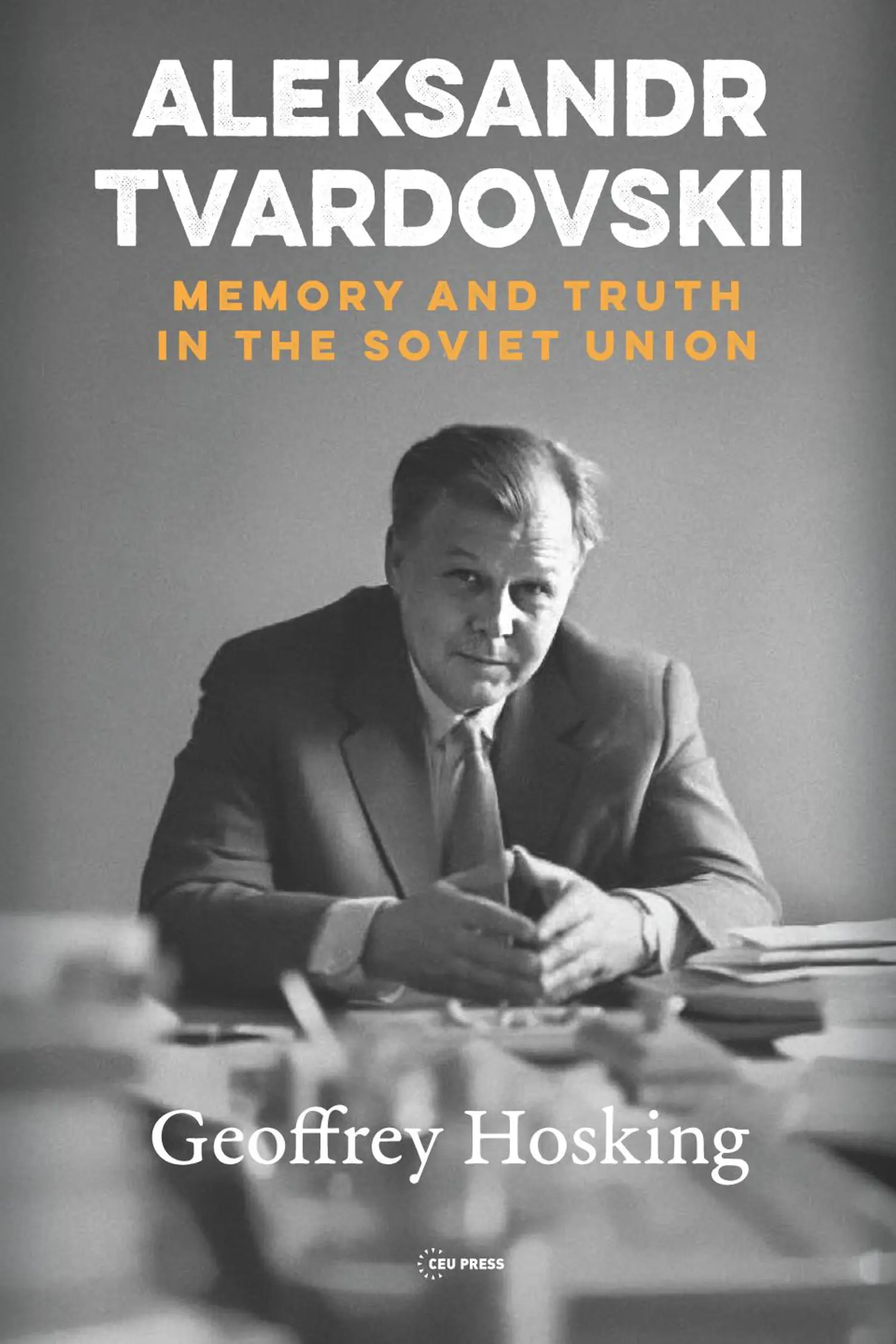
Published by: Central European University Press
For lovers of Russian literature, the name Aleksandr Tvardovskii evokes a whole era. George Hosking’s new publication, Aleksandr Tvardovskii: Memory and Truth in the Soviet Union, finally gives Tvardovskii an English-language biography that approaches him with the room for complexity that his story requires. Hosking became interested in Aleksandr Tvardovskii on reading his wartime poem “Vassili Tyorkin” and then learning about his cultural relevance as an editor. From 1950 to 1970, with a four-year interlude between 1954 and 1958, Tvardovskii was the Editor-in-Chief of Novyi Mir, a dense journal which became one of the most important venues of discussion during the Thaw. During his editorship, Novyi Mir launched what is arguably its most famous publication, Aleksandr Solzhenitsyn’s A Day in the Life of Ivan Denisovich, but also Ilia Ehrenburg’s memories, Vladimir Pomerantsev’s On Sincerity in Literature, Emil Kardin’s Legends and Facts, and Natalya Baranskaya’s A Week Like Any Other.
Tvardovskii is usually portrayed either in a laudatory tone as a man who took personal risks to speak truth to power and defend literature, or in an accusatory tone as a true believer in the regime, a man who witnessed his family’s arrest as kulaks and may have even reported them when they tried to escape. Hosking, in this biography, allows him enough humanity that we can accept that he was both these things, not an unblemished hero or the gullible true believer depicted by Solzhenitsyn, but a man whose struggles reflected the dilemmas and changes of his century.
Hosking structures his account chronologically, starting with Tvardovskii’s childhood as the son of a blacksmith in Zagorye, in the province of Smolensk, with an early interest in socialism and literature. He had early literary success with the publication of the poem “Strana Muraviya”, which managed to speak about collectivization with a mix of genuine belief in the Soviet system and lyric candor.
One of the greatest strengths of the book is the attention it pays to Tvardovskii’s poetry, which is often overshadowed by his work as an editor.
Some of the most vivid moments of the book come from the description of Tvardovskii’s second tenure at Novyi Mir, between 1958 and 1970. In 1957, Tvardovskii wrote down his credo: that novels should be realist; of high literary quality; internally and externally indispensable, coming from an internal place where the writer feels he has to write it, but illuminating the world to the audience; that they should have an objective theme, not being entirely centered on the author’s concerns; and that they should be comprehensible for a broad section of the population. Hosking uses diaries, memoirs, correspondence, and archival sources to reconstruct how these ideas affected the journal’s editorial culture, showing how Tvardovskii and his colleagues transformed the journal into a moral reference point for the Soviet intelligentsia. The journal became so relevant that during the Siniavskii-Daniel trial, considered the event that put an end to the Thaw, it received hundreds of letters about the trial, in spite of its tangential connection to the case.
One of the greatest strengths of the book is the attention it pays to Tvardovskii’s poetry, which is often overshadowed by his work as an editor. A great deal of attention is paid to his war-time verses, “Vassili Tyorkin”, as well as the posthumously published “By the Right of Memory”, in which Tvardovskii attempts to address the guilt and trauma of his family’s deportation. Hosking also approaches a book Tvardovskii planned, but never completed, Pan Tvardovskii. Pan was the Polish honorific by which his father was known in the village, but Pan Tvardovskii is also a Polish folk story, a Polish Faust. The extensive excerpts of the verses are especially valuable for English speakers, since only a few of Tvardovskii’s long poems were translated, and very well used by Hosking to analyze the themes that Tvardovskii explored throughout his life.
Tvardovskii’s life and dilemmas are far from unique in Soviet popular culture, and Hosking comments that he had a similar trajectory to Writer’s Union president Aleksandr Fadeev, and to fellow war correspondent and war poet Konstantin Simonov. The worries about how to reconcile the moral responsibility of speaking out against injustice and the personal cost are also not relegated to the past, but seem increasingly close to us once more. In our interesting times in which the Berlinale, once proudly known as the most political festival, tries to divorce art and artists from politics, and Irish authors fear being labeled terrorists in the United Kingdom for activism, we may finally be ready to accept Tvardovskii’s ambiguities and contradictions, and hope we have the same capacity to reflect on our own lives.
Julia Boechat Machado is a historian working on Soviet book history. She is currently doing a PhD in Comparative History at Central European University and is the bibliography editor at the Society for the History of Authorship, Reading and Publishing (SHARP). Her current research is on Tamizdat publishers in the Late Soviet period.