

The long end to Habsburg Central Europe’s long nineteenth century
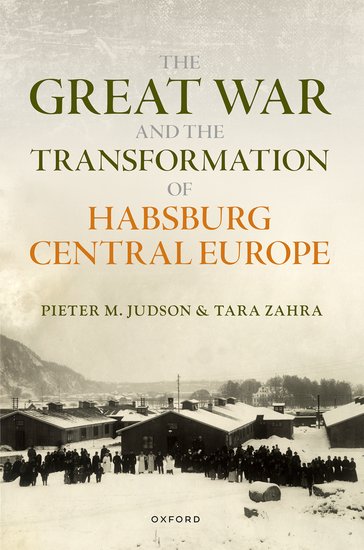
Published by: Oxford University Press
It is rare that two academics, one-time teacher and undergraduate, friends for more than a quarter of a century, co-author a book. Part of Oxford University Press’s distinguished Great War Series, this volume addresses a topic in which they have an abiding interest: The First World War in Habsburg Central Europe, broadly construed. Pieter M. Judson and Tara Zahra analyze the war, not as the end of the Monarchy, but rather as a series of socio-political changes that helped lay the groundwork for a new, previously unimaginable, postwar world. They address how government officials dealt with complex issues ranging from gendered citizenship through the construction of refugee camps to the provisioning of refugees and occupied peoples. This relatively brief, innovative volume is organized in seven evocatively titled, topically organized chapters. It is packed with interesting observations and rewards careful reading.
The authors’ arguments fit squarely within the recent historiography of the region. First and foremost, the authors reject the November 11, 1918 Armistice on the Western Front as the end of the Great War throughout Europe. Rather, it marked the start of a time of revolution and counter-revolution in part of the region. Moreover, they don’t analyze the war as part of the Austria-Hungary’s alleged long and painful decline. They point out, as others have done, that the Monarchy was not on life support in July 1914, when the elderly Habsburg Emperor Francis Joseph declared war on neighboring Serbia.
While the war played an important role in the dissolution of Austria-Hungary, its legacy equally importantly affected the domestic relations of the so-called “successor states,” and the new order laid out at the postwar Paris Peace Conference. “Self-determination of peoples” became the language of popular interwar democratic governance. That most of the successor states were multi-national states ruled as nation states was a problem that increasingly made itself felt during the growing authoritarianism of the 1930s. Indeed, decisions made at the Paris Peace Conference and the Treaty of Lausanne in 1923, including what even into the 1990s were euphemistically designated “transfers,” marked the beginning of a century of expulsions, forced movements of populations, ethnic cleansing, even genocide, in the name of self-determination and democracy. The result, as the authors write, was untold numbers of refugees and stateless persons. New international institutions that developed in the early interwar period oversaw the fates of these people.
The Habsburg warfare state considered camps a solution for interning suspect populations and accused traitors from the lesser classes—here’s looking at you, Italians and others—as well as POWs.
The men who administered the warfare state considered refugee and POW camps social experiments. In addition to housing and feeding these people, authorities had to provide healthcare and prevent the spread of disease. Austria-Hungary had refugees from almost the beginning of the war as Russian troops streamed into Bukovina and Galicia in the imperial east. What to do with them? The authors write that officials sought to solve the crisis by building barracks and camps, which they considered easier to provision rationally, while preventing the overcrowding of cities as well as conflict between locals and newly arrived refugees. The first camps opened in autumn 1914 for refugees from the Eastern Front, followed by camps for refugees from the Italian Front the following summer.
Internment and refugee camps developed in parallel. As the authors note, the distinction between the two kinds of camps was unclear to many refugees who were not best pleased to find their freedom of movement limited. (p. 85) The Habsburg warfare state considered camps a solution for interning suspect populations and accused traitors from the lesser classes—here’s looking at you, Italians and others—as well as POWs. The question of what these suspect people might write to those back home kept the Monarchy’s army of censors busy during the war. Moreover, there were never enough camps, or housing, and the locals and the refugees sometimes came into conflict, as Kathryn Densford has observed.
The declaration of war in July 1914 complicated the issue of citizenship, which as the authors note was a legal status that had heretofore only rarely intruded in daily life. (p. 103) During wartime, “citizenship” took on new meaning. Female citizenship was complicated, contingent as it often was on women’s male relatives. Would authorities deny women married to men from belligerent countries certain benefits or even deport women of the Monarchy who had known no other homeland? Even more complicated was the situation of emigrants to the Western Hemisphere: Where did their loyalty lie, especially after the United States entered the war in late 1917? And what would they do at the war’s end?
Judson and Zahra’s discussion of POWs addresses both Habsburg soldiers in Russia and Russian soldiers in the Monarchy. Building on the important work of Iris Rachamimov and others, including Elsa Brändström’s sometimes overlooked memoir, the authors detail the different treatment of soldiers by rank and location. The Russians followed the Hague Conventions for officers, which meant, among other things, no forced labor and a standard of living that was often higher than that of the local populations. (p. 94) The rank-and-file POWs in Russia did not have the same benefits. Indeed, the least lucky ended up among the 70,000 POWs who joined Chinese, Russian, and other workers and convicts constructing the Murman railway, which linked Petrograd and the port of Murmansk on the Arctic. Tens of thousands perished. (pp. 98-99) Austro-Hungarian POWs’ homecomings were also fraught as the authors explain: Returnees were subjected to medical quarantine and “re-education,” the latter owing to their possible exposure to Bolshevik ideas after March/October1917. Moreover, it’s not as if all the POWs received a particularly warm welcome upon arrival home: After all, they weren’t meant to lose.
The authors describe the various local, regional, and monarchy-wide organizations that mobilized after 1914 to provide relief for widows, orphans, refugees, as well as soldiers/veterans and their families. Indeed, one of the lasting, significant consequences of the war was the European-wide conviction that states owed something to their citizens who fought, died, worked, and lost their homes for the war effort. (p. 166). This was a conundrum in some of the successor states: Who would pay?
Indeed, some of its innovative wartime policies were carried on into the interwar era, if not in ways their creators imagined.
Zahra and Judson remind us that March/October 1917 weren’t the only revolutionary uprisings between 1914 and 1918. Moreover, local and regional conflict and tension exploded as national majorities began to seize control in the former Austria-Hungary. The First World War’s end was slow and bloody in parts of Habsburg Central Europe, nowhere more than the Civil War in Hungary and the war between Poland and Ukraine.
The legacy of the Monarchy loomed large among the leaders of the successor states. Indeed, some of its innovative wartime policies were carried on into the interwar era, if not in ways their creators imagined. Categorizing people, an issue in Austria-Hungary, was also important in these new “national” states because it often determined access to citizenship, political rights, and resources. (p. 163) The continuation, sometimes, distortion, of some Habsburg policies helped lay the groundwork for genocidal explosions beginning in the 1930s.
The book’s footnotes (no endnotes to make the reader flip impatiently back and forth) reveal the authors’ use of a wealth of primary and secondary sources, most in English and German, but including Czech, French, Italian, and Polish. The authors worked not only in the Viennese archives, but also in archives in Cracow, Trieste, and elsewhere. In addition to Maureen Healy’s classic socio-cultural study, and Tamara Scheer’s numerous publications on issues of nationalism in and around the Habsburgs’ last war, the authors also cite Ke-Chin Hsia and Máté Rigó’s more recent monographs. The war diaries, memoirs, and novels of well- and lesser-known Habsburg authors are all there. A book that cites so many useful sources ought to include a select bibliography, or at least suggestions for further reading. Moreover, there is a list of figures and maps, but no list of abbreviations that would allow the non-archive rat reader to know to which archive, collection, and file the footnote is referring.
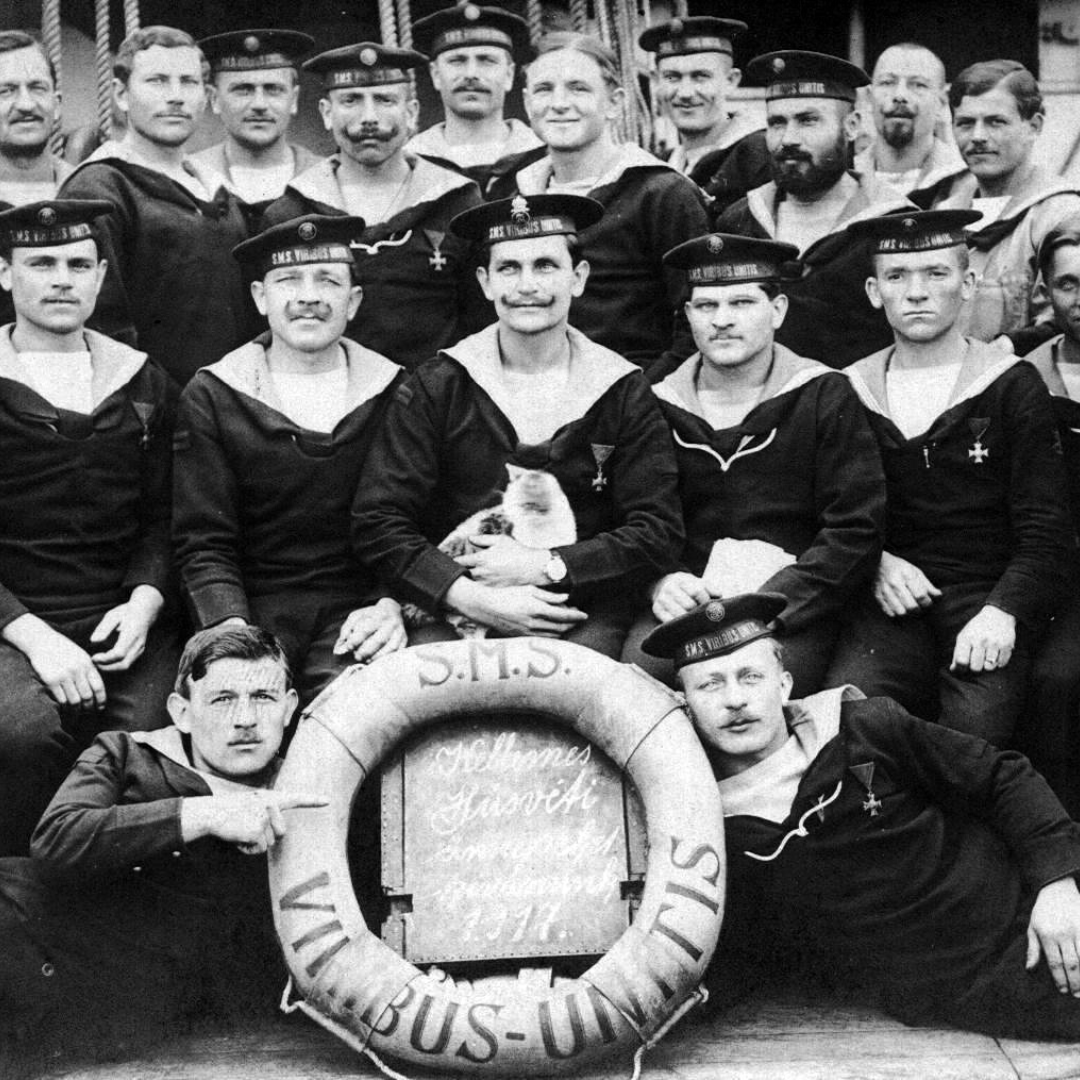
The Great War includes three useful, well-designed maps at the front of the book. The volume also includes numerous images of both the fighting and the home fronts as well as POW and refugee camps and elements of material culture. My favorite image, however, is none of the above. It is the picture of the authors on the dust jacket flap. They’ve just finished a strenuous hike in the mountains of central Italy.
In sum, this exceptional book is well worth reading. Elegantly written, it should be great fun to teach, well worth assigning to upper-level undergraduates and graduate students. Graduate students, look for it on your orals lists soon.
Nancy M. Wingfield, Distinguished Research Professor Emerita, Northern Illinois University is the recipient of the Czech Academy of Sciences’ František Palacký medal for contributions to the historical sciences. Author of numerous articles and books on Habsburg Central Europe, including the award-winning The World of Prostitution in Late Imperial Austria.