

The poisonous sisterhood of early 20th-century Hungary
Published by: Brazen Books
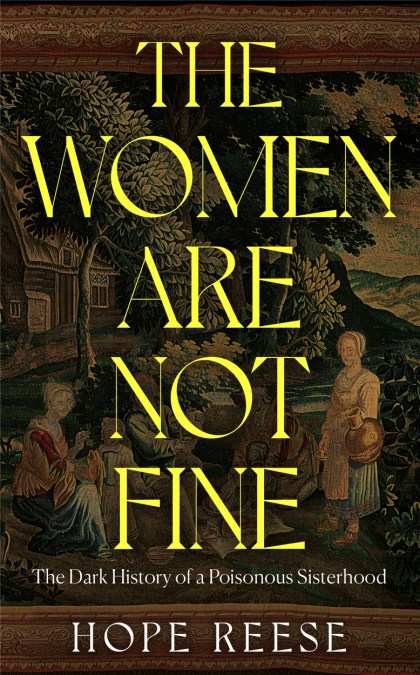
This is a chilling tale of what happens when women come together not in celebration of sisterhood, but in a desperate pact for survival. In The Women Are Not Fine, American journalist Hope Reese transports readers to early-20th-century Hungary, to the rural village of Nagyrév. It is here that Reese uncovers the dark and haunting history where a network of abused women used arsenic-laced flypaper to quietly and carefully poison their cruel husbands. While true crime media is overly saturated with sensationalized shock value, Reese transcends this modern-day cliche. Instead, she uses this grim historical event to ask uncomfortable but necessary questions about institutional failure, isolation, and the ultimate limits of women’s endurance. This book serves not as a mere retelling of forgotten crimes but as a deeply unsettling sociological puzzle about what happens when society completely turns its back on vulnerable people.
To better understand how such an extraordinary conspiracy took root, Reese reconstructs the suffocating atmosphere of rural Hungarian patriarchal history. At the turn of the century, the women of Nagyrév lived under rigid control where domestic abuse was treated merely as a private family matter and where legal and financial independence was entirely out of reach. With no phones, television, or outside communication channels, these women survived through hidden, tight-knit social circles functioning almost as hives of shared grief. The book captures the psychological complexity of these relationships brilliantly, portraying how extreme poverty, wartime trauma brought home by returning First World War soldiers and a total systemic abandonment can transform basic survival instincts into a dark, collective plot. The women are often praised and referred to as angel makers, but Reese navigates the moral ambiguity with immense care, avoiding simplistic hero worship whilst simultaneously refusing to write them off as simple cartoonish monsters.
when the state, the church and the law turn a blind eye to systemic violence, what alternative does a marginalized group have?
The book does not treat the village as a bizarre anomaly, but instead Reese considers and places these women within the context of a wider cultural system that gave them no other choices or escape routes. The midwife and arguably one of the most well-known persons in the trial, Zsuzsanna Fazekas becomes a chilling figure of dark comfort offering a lethal solution to women who had exhausted every legal and social avenue. The author does a magnificent job of exploring how secrecy operated in a micro-society where everyone knew each other yet collectively kept the secret safe for over two decades. The book forces readers to grapple with an uncomfortable question – when the state, the church and the law turn a blind eye to systemic violence, what alternative does a marginalized group have?
The Women Are Not Fine has been impeccably researched and Reese excels at breathing narrative life into historical archives through her deep dive into court records, police reports and historical data. However, her structural and content choices occasionally falter, most notably in how she handles and presents contemporary domestic violence. Later in the book, Reese supplements the story by adding an additional chapter on domestic abuse. This chapter, whilst at its outset, seems like a good idea, ultimately leaves readers baffled. The main issue stems from a stark geographical mismatch as the author analyzes modern domestic violence primarily through a U.S perspective, largely ignoring today’s statistics, legal frameworks and social realities in Hungary and the surrounding regions.
It serves as a haunting reminder of what happens when society fails women who need help, making it an essential and eye-opening read.
Given that the book is deeply rooted in the history of Hungarian women through the events of Nagyrév, it would have been far more valuable for the book to provide an overall evaluation of the situation in Hungary today. By applying a broad Americanized lens to a localized Central European tragedy, the book misses a crucial opportunity to bridge the past and present meaningfully, despite the rigorous historical research backing the rest of the text. This oversight creates a noticeable disconnect in an otherwise tightly woven narrative, pulling the reader out of the specific historical world Reese built so carefully.
Overall, this book is compelling for its gripping narrative and its ability to resurrect a somewhat deeply buried piece of Hungarian patriarchal history with meticulous care. However, future editions would benefit immensely from a reshaping of the supplementary chapter to resolve the cultural and geographical mismatch. Despite this structural misstep, The Women Are Not Fine succeeds in forcing readers to confront uncomfortable truths about institutional blindness, desperate survival and the dark corners of the patriarchal past. It serves as a haunting reminder of what happens when society fails women who need help, making it an essential and eye-opening read.
Ultimately, whilst a lot has changed since the early 1900s, the patriarchy continues to uphold abusive standards and perpetuate systems that are inherently stacked against women. This book is highly recommended to every woman, especially in today’s society where true, meaningful solidarity is needed more than ever. We all need to pick this up because the truth is, the women are still not fine.
Sara Turnbull is a doctoral researcher at Lancaster University with a strong interest in education, gender studies, and social equity. Her research focuses on access to education for marginalized communities, with particular emphasis on girls’ education and the social and structural factors that shape educational opportunities. She is an avid reader and reads over 200 books a year.