

What does populism look like?
Published by: Brill
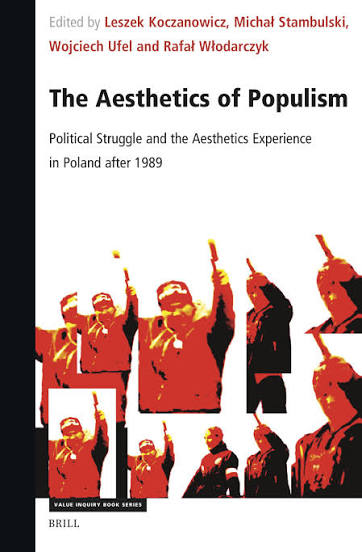
In recent years, there has been a concerted effort to focus on more than just what populist actors say, but also on how they act. Part of this is what Benjamin Moffitt labels mis-en-scene, but this volume expertly extends to aesthetics more broadly. Funded by Poland’s National Science Centre, the chapters within should be considered for any reading list on Poland or novel approaches to populism.
The introduction offers an important note: this text does not aim to be complete in its overview. This is refreshing in an era of literature that overpromises and under-delivers. The book is placed firmly within a Polish context and this is briefly contextualised with the note that memory and populism in Poland have often been seen through a right-wing lens. This would have benefited from further development: who are the right-wing actors they discuss? Nonetheless, the point made is reasonable, with a clear prominence of historical memory as part of the populist aesthetic of right-wing actors in Central and Eastern Europe.
Turning to its chosen case study, post-Communist Poland, the book is divided into three sections: the aesthetics of democracy and populism, populist imaginaries and symbols, and representations of protest and resistance. Initially, I was struck by these titles and the potential for crossover, concerned that they may not be distinct enough. This was a largely unfounded concern. The chapters fit neatly into sections that together provide a thorough, comprehensive exploration of particular themes.
It provides one of the most accessible and interesting approaches I have encountered, building effectively by using Laclau and Ranciere.
The first section is in my view the weakest. This is not to critique Woodford’s fantastically written, clear explanation of Lefort’s view of democracy. It provides one of the most accessible and interesting approaches I have encountered, building effectively by using Laclau and Ranciere. It is a chapter I would point to for any discussion of democratic theory. Yet, in a book marketed so heavily as an exploration of a particular case study, to open without a discussion grounded in the specific case felt like an omission: one may expect this in a literature review, but for an edited volume on Poland, it feels disjointed, and may miss many of the readers on democratic theory who would benefit from such a text.
This section ends where Populist imaginaries and symbols start: the newspaper Gazeta Wyborcza between 1989 and 1993, with two chapters by Jan Sowa. The second chapter on the newspaper is a highlight of the book. At a time when the broader literature is addressing the role that the media plays in mainstreaming and normalising populist actors, Sowa excels in his outline of the role of Poland’s liberal press in normalising inequality and thus strengthening populist opposition. The later chapters on pop culture and literature are refreshing and provide insight into fields that I would not have considered as the usual route for populist attitudes or aesthetics.
My main interest in the text, beyond Poland as a case study, is Chapter 10. Rafał Węgrzyn’s chapter on non-mainstream news portals should be read by anyone working on so-called alternative news sources. We have an increasing knowledge of what these platforms post and how they work. The motivations of those working for them, and what they themselves consume, is, however, understudied. Through a focus on Polonia Christiana, Magna Polonia, and Lewica, Węgrzyn’s use of the CLARIN platform and the KonText tool provides insight into an incredibly large volume of data through a quantitative analysis. Later content analysis is limited however, and I would have liked to see this further developed beyond just the conclusion. References to the broken windows theory and the final paragraph’s discussion of Koczanowicz is similar: interesting, but underdeveloped. This is perhaps most obvious in relation to broken windows – a key approach of criminology, and one whose relevance to film and media consumption is at best tangential.
does the approach to aesthetics vary upon which definition an actor fits? Does a Muddean populist appear and act differently to one in the view of Laclau or Weyland?
Section three provides insight into the aesthetics of protest movements in Poland. This is of perhaps the broadest use to scholars and students. With Poland’s history of street movements in recent years, the text covers a broad range from women’s and teachers’ strikes through to the Polish nationalist movement. These chapters also boast the strongest transferability to elsewhere in Central and Eastern Europe, with Slovakia, the Czech Republic, Romania, and Hungary all seeing prominent street protests in the years since the COVID-19 pandemic. The chapter on populist themes in hip-hop music produced during that pandemic is novel, and it would be interesting to see if this replicates across genres and countries.
One potential criticism of the book is its relatively broad stroke approach to populism. References are made to the work of Cas Mudde and Cristobal Rovira Kaltwasser, to Jan-Werner Müller, to Ostiguy. Yet it is challenging to place it within any particular approach. Certainly, it would be easy to see overlap with Moffitt’s work also, as referred to in the introduction of this review. So how then should we understand this book? I propose that this book should be understood as an extension to populist literature more broadly, expanding theory into the aesthetic, an arena the authors themselves note has thus far been underexplored. This mirrors the way policy areas approaches such as penal populism and medical populism have often employed looser approaches to populist theory than building upon any individual approach. Whilst it is possible to see this as a criticism, it is also potentially an opportunity for future researchers: does the approach to aesthetics vary upon which definition an actor fits? Does a Muddean populist appear and act differently to one in the view of Laclau or Weyland?
There is great potential in the ideas and theories presented, although at times they require further development in their integration with the broader literature. This book nonetheless represents a fantastic starting point for a burgeoning field. As a potential next step, it would be beneficial to see this aesthetic focus applied to political actors themselves: do they mirror the broader societal trends this book identifies?
Jack Dean is a Ph.D. candidate at University College London’s School of Slavonic and East European Studies, where he researches Central and Eastern Europe. His research interests focus on populist politics and the politics of health. Outside of academia, he comments on unfolding political affairs in Europe, particularly regarding Romania.