

Women and reproductive politics in socialist Yugoslavia

Published by: Indiana University Press

In March 2024, headlines around the world celebrated France for becoming the first country to enshrine the right to abortion in its national constitution. The coverage was enthusiastic, even historic. What many forgot was that Yugoslavia had done precisely this half a century earlier. The 1974 Yugoslav constitution affirmed parents’ right to decide freely on the number of their children, and the country had already decriminalized abortion in the 1951 penal code, legalizing it fully “on demand” by 1969. Yet this history has remained curiously absent from contemporary discussions of reproductive rights, revealing how quickly socialist legal innovations disappear from global memory.
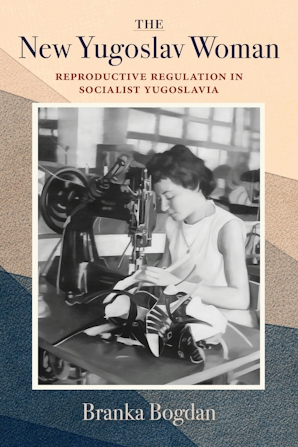
Into this historical amnesia enters The New Yugoslav Woman by Branka Bogdan, published by Indiana University Press. More than a reminder of what has been forgotten, the book offers a rigorous study of the disjuncture between constitutional promise and lived experience. Bogdan examines reproductive regulation in socialist Yugoslavia between 1945 and 1989, mapping the distance from the first postwar constitutional promises of equality to the intimate, often painful reality behind the clinic door. The book asks, with quiet insistence, what it means for a state to guarantee a right that its own practitioners may deny in practice – and what it meant to be the Nova Jugoslavenska Žena (Serbo-Croatian for New Yugoslav Woman) in body and not only in slogan.
Bogdan structures her argument both chronologically and thematically across five chapters, moving from the legal foundations of the postwar state (the 1946 constitution and the 1951 penal code) through the medicalization of reproduction, the development of contraceptive technologies, and the evolution of sex education and family-planning policy, before culminating in the oral histories that ground the book’s central arguments. The sweep is impressive. Bogdan follows the evolution of contraception from contraceptive pills and the diaphragm to the Yugoslav-developed intrauterine device (IUD), while revealing the stark contradictions of reproductive medicine: gynecologists appear as agents of both clinical innovation and clinical contempt, calling women derogatory names such as “whores” in the clinical setting and withholding pain relief during abortions even when it was available. The distance between the progressive law and the humiliating examination room is the book’s central tension, and Bogdan holds it with admirable steadiness.
unmarried women feared the shame of seeking birth control advice, IUDs were distrusted, and pills were inconsistently supplied.
The book’s most distinctive quality is its commitment to what historians call Alltagsgeschichte – the history of everyday life. Bogdan does not confine herself to policy documents and party resolutions. She reads women’s magazines, advice columns, AFŽ bulletins, and the gynecological surveys of ordinary patients. She listens. The opening anecdote sets the tone: a 1958 letter to the Croatian fashion magazine Svijet, in which an anonymous woman confesses that she already has four children, has had “a few abortions already”, and lives in fear. The gynecologist’s reply is almost entirely political – a celebration of the state’s commitment to women’s health—rather than medically useful. This gap between what the state said and what women heard runs through the decades covered in the book.
The women Bogdan interviewed – mostly urban, educated, and modern – describe a world in which contraception was technically available but emotionally fraught: unmarried women feared the shame of seeking birth control advice, IUDs were distrusted, and pills were inconsistently supplied. “If she wanted an abortion, she would just go and get one,” one interviewee recalls. That apparent ease, Bogdan shows, masked a far more arduous process: lining up at dawn, submitting paperwork to a hospital commission, paying fees, seeing a social worker, and ultimately facing one’s family and community if it became known. Legal did not mean painless. Legal did not mean dignified.
Bogdan is admirably transparent about the scope of her research. She writes explicitly from the vantage point of three metropolitan centers – above all Ljubljana, with its remarkable Institute for Family Planning founded in 1961, but also Zagreb and Belgrade – while acknowledging that women’s experiences of healthcare “varied dramatically between the metropolises and villages”. This honesty is welcome. But it also points to the book’s most significant limitation: the periphery is present in the data but absent in the testimonies. The book presents Macedonian women, Bosnian women, and women from small Dalmatian towns, but often indirectly – in statistics, surveys, and demographic reports – rather than through their own narrated voices. The New Yugoslav Woman of the title is, in practice, largely an urban middle-class woman. A book centred more fully on women from the Yugoslav periphery would have been very different, and perhaps more unsettling.
By situating Yugoslav reproductive regulation within transnational conversations about population control, human rights, and socialist modernization, Bogdan demonstrates that this is not merely a regional story.
Nowhere is this gap more pointed than in the treatment of Kosovo. Bogdan documents, carefully and without sensationalism, the consistently low rates of contraceptive use and high fertility in the region: in the 1970–1974 band, Kosovo’s fertility rate was roughly twice the national average; by the mid-1980s, barely a quarter of Kosovar women used any form of contraception. She notes that state demographers grew increasingly “alarmed” by these figures, that Kosovo was repeatedly coded in official reports as “backward,” and that Albanian women were described in women’s press coverage as needing to be “lifted” toward an implicitly Slovenian ideal of modernity. What the book does not pursue with sufficient critical pressure is the ideological machinery behind this demographic anxiety – the ways in which Serbian nationalist demographers weaponized Kosovo’s birth rate as a civilizational threat, a discourse that fed directly into the politics of the decade’s violence. The demography of Kosovo was never merely a health question. By not pressing further on this point, the book leaves one of its most charged threads unresolved.
These are criticisms that the book’s own methodological generosity invites, and they do not diminish its considerable achievement. By situating Yugoslav reproductive regulation within transnational conversations about population control, human rights, and socialist modernization, Bogdan demonstrates that this is not merely a regional story. The contradictions she uncovers – between progressive legislation and punitive practice, between the rhetoric of equality and the hierarchies it concealed, are not uniquely Yugoslav. They are the contradictions of every state that has ever used women’s bodies as a measure of its own modernity.
Sara Žerić Đulović is a social historian and has been a researcher at the Leibniz Institute for East and Southeast European Studies since 2022. Her research focuses on the second half of the twentieth century, with particular emphasis on migration, labor history, and gender history. She is also an associate of the Center for Cultural and Historical Research of Socialism in Pula.