

Yugoslav cultural diplomacy and the Global South

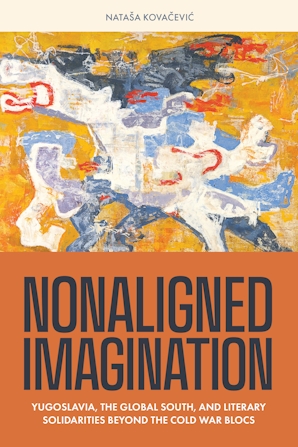
Published by: Northwestern University Press

In Nonaligned Imagination, Nataša Kovačević sets out to recover what she terms the “forgotten cultural history of the Non-Aligned Movement” (p. 2). By tracing transnational encounters and the networks that emerged among Yugoslav writers, academics, literary critics, and diplomats (roles that often overlapped) and their counterparts across the Global South, she shifts the analytical focus away from state-centered narratives toward what she conceptualizes as non-alignment from below. From this perspective, institutionalized and officially orchestrated forms of transnational exchange recede into the background, against which the dynamics of interpersonal relationships were set.
The book is divided into four chapters and a coda. The first chapter centers on the non-aligned revolutionary travelogue as a key genre through which encounters with the decolonizing world were narrated and conceptualized. Travelogues also remain central in Chapter 2, though here their explicitly anticolonial dimensions move to the foreground. The second half of the book shifts the emphasis from genre and discourse to networks and practices, including translation networks, and traces the spillover of decolonial concerns into multiple discursive and institutional spheres beyond cultural production.
Kovačević places particular emphasis on forms of cooperation that were often unintended, informal, or contingent, treating them as a window onto the affective dimensions of non-aligned encounters. One of her central analytical concerns is to capture the simultaneous presence of affective proximity and relational distance, and to unpack the theoretical, political, and positional factors that structured these relationships, as well as to identify moments in which affective solidarity materialized. A further core objective is to demonstrate how Yugoslav intellectuals articulated lines of thought that engaged with, or in some cases anticipated, later canonical works of decolonial theory.
Kovačević shows that engagement within the former framework was openly acknowledged as ambiguous and marked by uncertainty.
The study builds on recent scholarship on Yugoslav engagement with the Global South and,1 like much of this literature, remains primarily focused on Yugoslav contexts.2 At the same time, the subject matter allows for an expansive geographical reach across Africa and Asia. As cultural exchanges between the socialist world and the Global South have become an increasingly vibrant field of research in recent years,3 Kovačević’s work aligns well with broader efforts to show that European state socialist regimes were far less isolated internationally than previously assumed. Moreover, it contributes to this literature by demonstrating how engagements with the decolonizing world generated alternative intellectual and material circuits of exchange distinct from those offered by the “West.”4
The evidence presented in the book indicates that the protagonists were negotiating their positionalities within a triangular geopolitical framework encompassing the “West,” the Eastern Bloc, and the Global South, as well as along a second axis that, while not entirely detached from this configuration, was structured by the opposition between (neo)colonial and anticolonial camps. Kovačević shows that engagement within the former framework was openly acknowledged as ambiguous and marked by uncertainty. By contrast, an anticolonial stance was consistently and coherently articulated from Yugoslavia’s semiperipheral perspective and functioned as the most effective means of creating proximity among the actors involved. As a shared conviction, anticolonialism could, though not invariably, bridge otherwise incongruent attitudes, particularly where anticolonial thought did not translate seamlessly into practice.
One of the book’s distinctive contributions lies in its sustained engagement with ambiguity, which Kovačević foregrounds rather than resolves. She documents instances of incoherence and the persistence of hierarchical or developmentist modes of thinking, including the problematic registration of phenotypical difference and its association with cultural traits. The exoticization of women’s bodies emerges as a recurring phenomenon. At the same time, both the author and her protagonists resist treating the socialist world as a monolithic bloc. Especially in Chapter 2, Kovačević highlights how Yugoslav and non-aligned aesthetics diverged not only from Soviet models but also from Chinese modernism.
Acknowledging women’s more limited participation in these mobilities and literary networks, she makes a concerted effort to foreground women actors wherever possible
Beyond mapping previously largely unknown networks of writers and other cultural stakeholders, the study is distinguished by its meticulous engagement with translation practices, both direct and those mediated through major languages, as well as by its sustained attention to interpersonal relationships as structuring forces with decisive effects on visibility and circulation. The analysis does not end with the sphere of cultural production but extends to reforms and reform proposals concerning (Yugoslav) academic curricula, another domain in which decolonial considerations were gaining ground. By bringing analyses of networks and institutional structures into dialogue with the more content-driven focus of the first two chapters, the book offers a nuanced account of the cultural and material conditions under which a project of decolonizing academic curricula took shape in a European country during the Cold War, even as Yugoslavia itself was grappling with how to position its (multi)national culture toward dominant global actors.
Kovačević draws on a diverse and well-integrated source base, including archival documents related to institutional frameworks, literary and cultural scholarship reflecting academic knowledge production, and a wide range of literary texts, such as fiction, published diaries, creative non-fiction, and anthologies. Acknowledging women’s more limited participation in these mobilities and literary networks, she makes a concerted effort to foreground women actors wherever possible, which is a concern that remains relatively underexplored in the existing literature.
Overall, the book provides a rich and densely contextualized account of the emergence of non-aligned cultural production with a distinct aesthetic, examining both the process itself and the networks that sustained it, predominantly from a Yugoslav perspective. Yugocentrism as such does not constitute a methodological flaw, and Kovačević is transparent about the limitations entailed by this choice. Nonetheless, the book’s title may lead some readers to expect a more sustained engagement with non-Yugoslav non-aligned imaginaries than the study ultimately provides.
Réka Krizmanics is an Akademische Rätin at the Profile Area Global and Entangled History at Bielefeld University. Previously, she held a DFG Walter Benjamin Postdoctoral Fellowship in Bielefeld and a research fellowship at the Imre Kertész Kolleg in Jena. Her current projects explore global and entangled women’s histories of Eastern Europe and the Global South, with a particular focus on East and Southeast Asia.
1 Paul Stubbs, ed., Socialist Yugoslavia and the Non-Aligned Movement: Social, Cultural, Political, and Economic Imaginaries (McGill-Queen’s University Press, 2023).
2 Stubbs, Socialist Yugoslavia and the Non-Aligned Movement.
3 Kerry Bystrom et al., eds., The Cultural Cold War and the Global South: Sites of Contest and Communitas, Routledge Studies in Cultures of the Global Cold War (Routledge Taylor & Francis Group, 2021); Rossen Djagalov, From Internationalism to Postcolonialism: Literature and Cinema between the Second and the Third Worlds (McGill-Queen’s University Press, 2020); Theodora Dragostinova, The Cold War from the Margins: A Small Socialist State on the Global Cultural Scene (Cornell University Press, 2021); James Mark and Paul Betts, eds., Socialism Goes Global: The Soviet Union and Eastern Europe in the Age of Decolonization: A Collectively Researched and Written Monograph, First Edition (Oxford University Press, 2022).
4 James Mark et al., “Introduction,” in Alternative Globalizations: Eastern Europe and the Postcolonial World, ed. James Mark et al. (Indiana University Press, 2020).