

The power of protest in Central and Eastern Europe
Published by: Palgrave Macmillan Cham
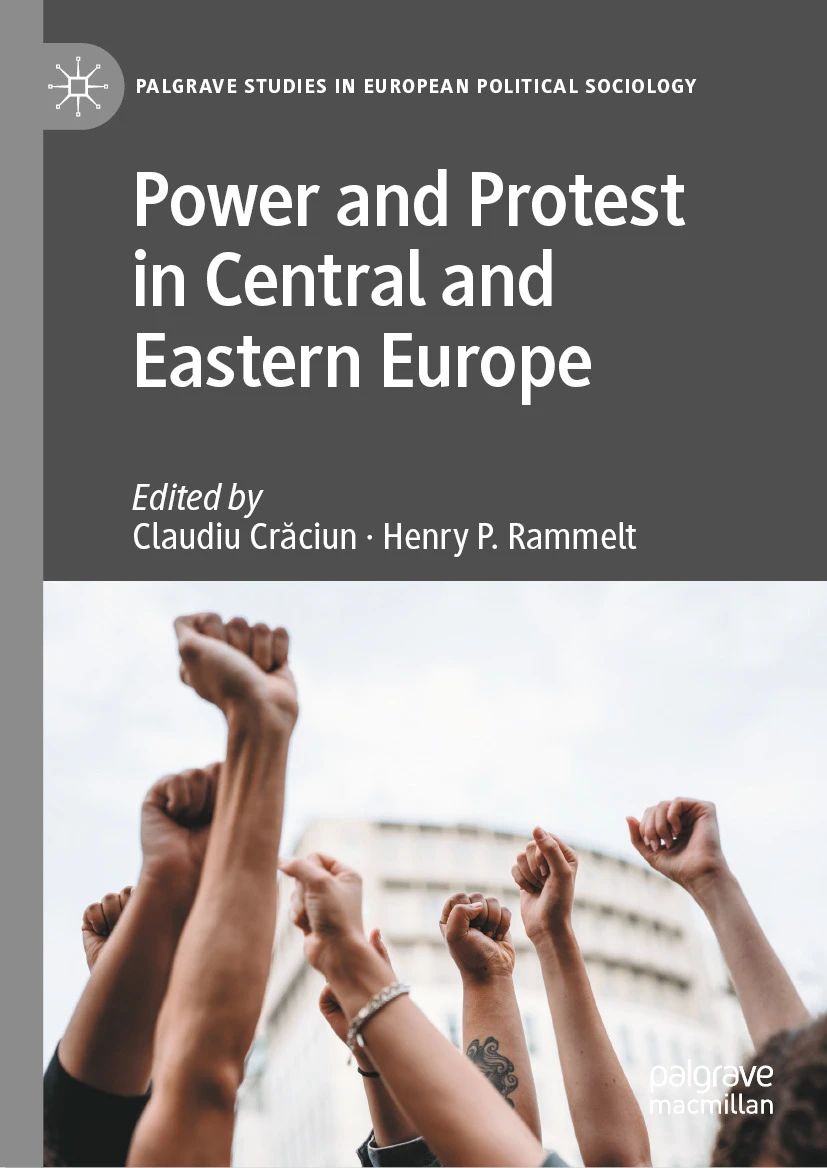
Power and Protest in Central and Eastern Europe attends to the ongoing dialogue between protests and political dynamics that have emerged since the transition in 1989. The book encapsulates the complex forces that continue to shape trajectories towards democracy across the region. This highlights the vital role played by civic engagement and protest in confronting the many challenges posed by highly centralized political power, limitations on political freedoms, escalating political repression, and the suppression of regime challenges by various means.
Through eleven country-specific case studies, the volume addresses reasons behind and intended outcomes of protests. The trigger-point of this history of protest is the triple transition (political, economic, social) towards democracy after the collapse of communism (see Offe, 1991) that affected Central and Eastern European (CEE) countries. Hence, protests and social movements are connected to each country’s move towards national and state sovereignty, opposition to their communist regime, attempts to establish democratic governments, and geopolitical recalibration.
It is understood that whilst formal organizations constitute the backbone of civil society, movements represent a dynamic part of this society, which facilitates the emergence of new issues and ideas (see Cohen and Arato, 1992). These social movements are seen as networks of actors who may be informal groups and/or organizations (civil society organizations, trade unions, or even political parties) engaged in political or cultural conflicts on the basis of shared collective identities (see Diani, 1992). In analyzing specific social movements, the volume succeeds in its aim to offer “a wealth of insights on how to sustain democratic practices, resist authoritarian tendencies, and ensure the resilience of democratic polities in the face of illiberal tendencies, not limited to CEE in their relevance” (p. 6).
The book does not attempt to identify a single issue or agenda underlining major protests, and it is all the richer for its resistance to homogenize the region.
This “wealth of insights” is reflected in the range of countries explored, many of which have been all too infrequently included in books about post-communist histories across CEE. As such, the book does not attempt to identify a single issue or agenda underlining major protests, and it is all the richer for its resistance to homogenize the region. This said, a structuring principle behind the order of chapters would be useful for the reader to identify parallels and differences more easily. With chapters structured alphabetically, the editors missed an opportunity to facilitate talking points based on the nature of protests (student-led, urban/rural), regional history (USSR, Eastern bloc), motivation behind protests (political rights, rule of law, ecological threats, civil liberties), or degree of protest suppression. Sadly, only Olga Zelinska, in her chapter on Ukraine, refers to another chapter in the same volume (see p. 311). It would have been beneficial to see more crossovers that highlight various political touchpoints across the region.
This lack of structure may explain the reason for the book’s four conclusions. Whilst each conclusion is valuable as a discrete essay, combined the conclusions become repetitive. This could have been partially avoided by turning David S. Meyer’s conclusion into a Foreword. Meyer’s remark that “[a]nalytically, it’s important to distinguish between the protest outcome of successful mobilisation – getting into the streets and making a strong statement – and political success – winning policy reforms or political gains” (p. 379) would be an apposite perspective to have in mind when commencing Power and Protest in Central and Eastern Europe.
Despite being placed as the third “country case” (due to a lack of judicious chapter structuring), all chapters benefit from Ivaylo Dinev and Dragomir Stoyanov’s explanation of the reason behind Bulgaria’s recent protest history. Due to its relevance across this volume, it is worth quoting in full:
But why does protest repertoire have such great importance for democracies in East-Central Europe? Part of the explanation is the critical juncture of the 1990s, the initial years of the transformation, when hopes met harsh social reality in most of the states, and three decades afterwards still part of the population perceived the socio-economic results as deficient and the political elite as corrupted. This led to constant political instability, frequent large protest mobilisations and the rise of protest parties and movement parties, a dynamic that is visible in most post-socialist states. (pp. 104-5)
Some of the book’s clearest examples of this complex dynamic behind protest culture are found in chapters by Gilda Hoxha (Albania, pp. 27-51), Kateřina Vráblíková (Czech Republic, pp. 109-37), Ivan Stefanovski (North Macedonia, pp. 191-217), and Piotr Kocyba (Poland, pp. 217-47).
Lea Ypi’s work on Albania’s communist history and Robert Austin and Artan Hoxha’s recent biography of Enver Hoxha (which I reviewed for the CEURB in June) have brought greater critical attention to Albania. In this volume, Gilda Hoxha argues that Albanian activism is shaping a culture of active citizenship (p. 44) despite the fact that “the political elite remains largely unchallenged” (p. 46). Hoxha attributes the growth of protests, including those concerning the protection of the Vjosa Valley, partly due to social media, which enables activists to circumvent unsympathetic mainstream media.
In the Czech Republic, Kateřina Vráblíková suggests that protests like “Million Moments for the Sake of Democracy” and “Stop the Government” have not led to systematic change due to “closed political opportunities” within political systems shaped by informal networks and corruption (p. 132). To reach this conclusion Vráblíková draws on Anna Grzymala-Busse and Pauline Jones Luong’s paper “Reconceptualizing the State: Lessons from Post-Communism” (2002), to highlight how post-communist state-building shapes the distribution of political authority and, consequently, prepares the ground for protest.
North Macedonia’s “oscillating” or “shallow” democracy that flits between democracy and authoritarianism
This unequal distribution of political authority is identified by Ivan Stefanovski as the main reason behind North Macedonia’s “oscillating” or “shallow” democracy that flits between democracy and authoritarianism (p. 193). When identifying North Macedonia’s triggers for protest, Stefanovski draws on Juan Linz and Alfred Stepan’s (1996, p. 236) observation that international influences, the political economy of coercion and legitimacy, and the special legacies of totalitarian and post-totalitarian regimes destabilize democracies. Stefanovski links protest to youth unemployment, unjust privatization, and media corruption, which are all “spearheaded by systemic abuse of power” (p. 195).
Perhaps the most internationally relevant protests – given the Women’s Marches that manifested globally after Donald Trump was first elected in 2016, the spread of the #MeToo movement, and the US Supreme Court’s decision to overturn Roe v Wade in May 2022 – are to be found in Poland. Piotr Kocyba examines mass demonstrations against PiS’s “usual practice of passing controversial judicial reform laws” (p. 232), including the protests of 28 October 2020 across 410 cities. He identifies mobilization as “one of the most important challengers to PiS” (p. 234), with abortion at the heart of Poland’s political divide. Deborah Yashar’s (2005) argument that movement networks mobilize against persistent exclusion and authoritarian legacies would have been relevant to Kocyba’s discussion of Poland’s struggles over women’s and LGBTQ+ rights.
From this book readers will gain an understanding of the importance of social movements at various stages of democratization and de-democratization after 1989. Democracy is shown to be a fragile political form susceptible to overthrow and backsliding. Social class dynamics are also emphasized as relevant to political activism and the formation of collective identities across CEE. In some cases, readers can appreciate the role of major geopolitical cleavages in the forging of allegiances with Europe, the US, or Russia. As Donatella della Porta summarizes in her conclusion, the volume asks: “How can an inclusive society be constructed in an environment that is ripe of socio-economic inequalities caused by the transition to democracy itself? How can democratic actors resist democratic backsliding for full-scale authoritarianism? What is the role of progressive social movements in these processes?” (p. 339) These questions will likely inspire additional publications that explore the ways in which social movements shape society.
The strength of this book lies in each contributor’s determination to see protest as untamed, citizens as engaged, and contentious politics as changeable. As each case study suggests, this is not a naïve stance, it is one grounded in a history centered on the underdog’s fight for justice. Here, success is pursued, if not guaranteed. This measured perspective is a useful correlative to centuries of poetic invocations to rally, rise, and revolt.
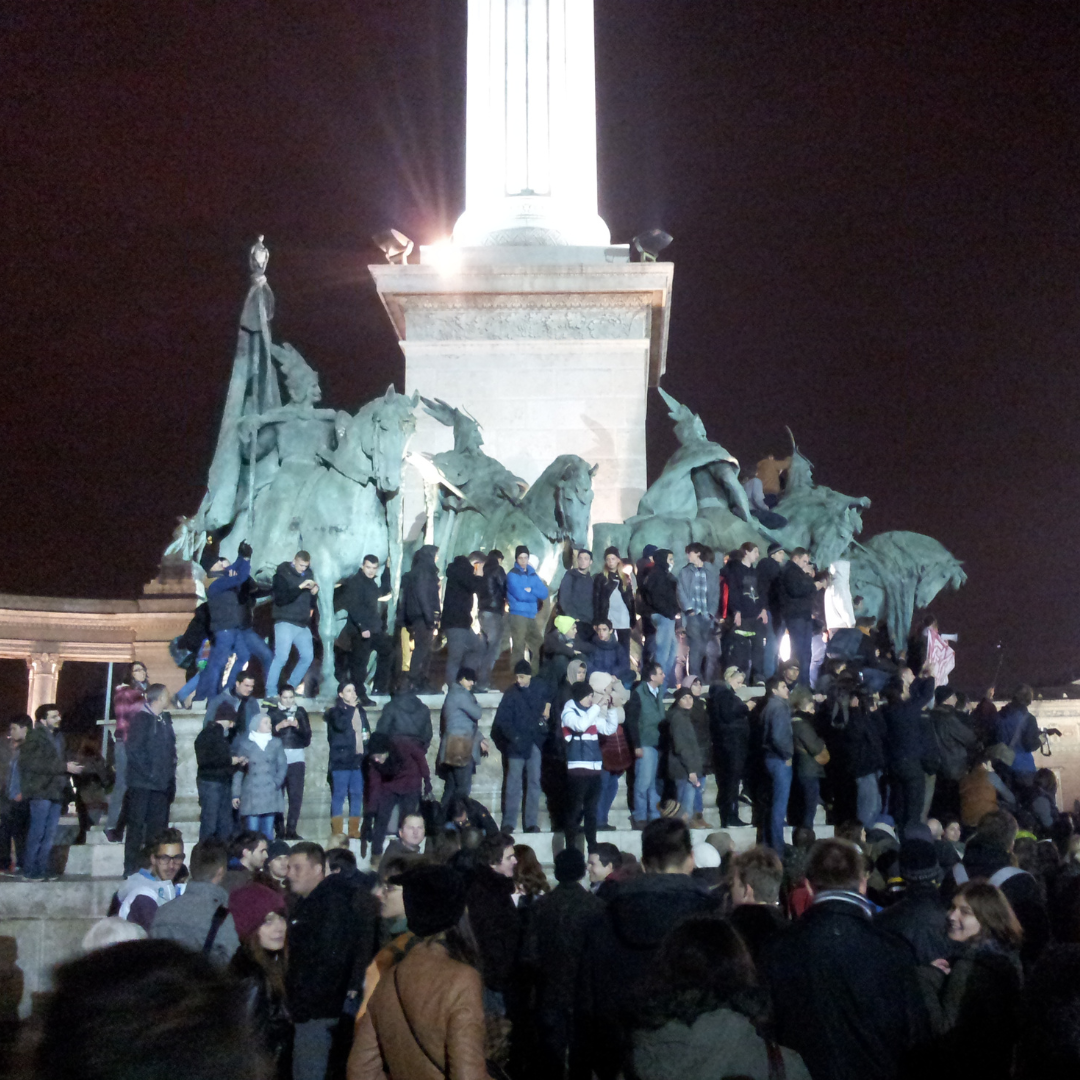
In 2025, the year of this book’s publication, protests took place across CEE motivated by the desire for greater freedoms and democracy. On 12 January Romanians gathered to oppose the Constitutional Court’s annulment of the 2024 presidential election after alleged Russian interference, on 24 January nationwide anti-Fico and pro-EU/NATO demonstrations concentrated in Bratislava, on 15 March a student-led protest against Prime Minister Miloš Vučević’s government swept through Belgrade, and on 28 June Hungarians protested in favor of LGBTQ+ rights and freedom of assembly. Now, more than ever, we need to look closely at the impact of social movements in light of changing political allegiances and with potential shifts of power on the horizon.
Lucy Jeffery is co-editor and author of Replaying Communism: Trauma and Nostalgia in European Cultural Production, published by CEU Press in 2026. She is also co-founder of the Replaying Communism project, which received funding from the AHRC SWW-DTP (2023) and the Visegrad Fund (2024). Lucy’s published research is on Samuel Beckett, Harold Pinter, Ezra Pound, Ingeborg Bachmann, and Magda Szabó. Her monograph—Transdisciplinary Beckett: Visual Arts, Music, and the Creative Process—was published by Ibidem in 2021, and, in 2022, she co-edited a special issue for Green Letters, entitled ‘A New Poetics of Space’. Lucy continues to publish on twentieth-century culture and is a frequent contributor to the CEU Review of Books.
Jean Cohen and Andrew Arató, Civil Society and Political Theory (MIT Press, 1992).
Mario Diani, “The Concept of Social Movement,” The Sociological Review 40, no. 1 (1992): 1–25.
Anna Grzymala-Busse and Pauline Jones Luong, “Reconceptualizing the State: Lessons from Post-Communism,” Politics & Society 30, no. 4 (2002): 529–54.
Claus Offe, “Capitalism by Democratic Design? Democratic Theory Facing the Triple Transition in East Central Europe,” Social Research 58, no. 4 (Winter 1991): 865–92.
Deborah Yashar, Contesting Citizenship in Latin America: The Rise of Indigenous Movements and the Postliberal Challenge (Cambridge University Press, 2005).